What Is Polymarket: How the Decentralized Prediction Market Works
Polymarket is a decentralized prediction market where users trade yes-or-no outcome shares on real-world events using USDC on Polygon. Prices range from $0 to $1 and represent the market’s implied probability, allowing participants to express expectations through tradable positions that can be entered or exited before resolution.
This guide explains Polymarket’s mechanics, pricing logic, fees, and key risks—while also outlining how to use Bitget Wallet as a self-custody solution to access Polymarket and manage stablecoins securely!
What is Polymarket?
Polymarket is a decentralized prediction market where users trade shares on the outcome of real-world events, with prices directly representing implied probability. Users buy or sell positions that update in real time as market expectations change.
- Pricing model: Share price = implied probability (e.g., $0.70 ≈ 70%)
- Settlement: Winning shares pay $1.00, losing shares pay $0
- Transparency: Markets, trades, and outcomes are publicly observable
How Does Polymarket Work?
Polymarket works as a prediction market where users buy or sell “Yes” or “No” shares on real-world events, with each share priced between $0 and $1 to reflect the market’s implied probability. If the outcome is correct, the share settles at $1; if not, it settles at $0.
How Polymarket works step-by-step?
Most Polymarket markets price shares between $0.01 and $1.00, with the share price reflecting the market’s implied probability of an outcome happening.
Step 1: Choose a market
Pick a prediction question, such as “Will Spain win the 2026 World Cup?”
Step 2: Buy “Yes” or “No” shares
You choose the outcome you want to back. If “Yes” is trading at $0.42, the market is implying a 42% probability that Spain will win.
| $0.10 | ~10% | Market thinks the event is very unlikely |
| $0.25 | ~25% | Low probability outcome |
| $0.50 | ~50% | Event considered a coin-flip |
| $0.70 | ~70% | Market expects the event is likely |
| $0.90 | ~90% | Event is viewed as highly likely |
Prices move as new information emerges — qualification results, injuries, or betting market shifts. If the price rises from $0.42 to $0.58, you can sell early to lock in profit without waiting for the final.
Step 3: Hold or trade your position
After buying, you can either keep your shares until the event is resolved or sell them earlier if the market price changes in your favor.
Step 4: Wait for the result
Once the real-world event is finalized, the market resolves to the correct outcome.
Step 5: Settlement happens in USDC
- If Spain wins, your “Yes” shares settle at $1.00 in USDC per share.
- If Spain loses, your “Yes” shares settle at $0.
So in simple terms, Polymarket works by letting users trade outcome shares whose prices move like probabilities, with final payouts based on the real result.
How Is Polymarket Different From Traditional Betting**?**
Polymarket differs from traditional betting by functioning as a tradable probability market rather than a fixed-odds wager against a bookmaker. Instead of locking in a bet, users buy and sell outcome shares whose prices reflect real-time probability, allowing positions to be adjusted or exited before the event resolves.
| Market Type | Decentralized prediction market | Centralized sportsbook or bookmaker |
| How Prices Work | Share price reflects implied probability (e.g., $0.70 ≈ 70%) | Odds set by bookmakers (e.g., -150, +200) |
| Trading Mechanism | Users buy and sell shares before the event ends | Users place a fixed bet against the house |
| Settlement Value | Winning shares settle at $1, losing shares at $0 | Payout determined by bookmaker odds |
| Transparency | Trades and markets can be publicly observable on-chain | Betting odds and operations controlled by the platform |
| Liquidity | Market-driven liquidity from other traders | Liquidity provided by the bookmaker |
| Asset Used | Typically stablecoins like USDC | Fiat or platform balance |
Source: Polymarket.com
Why is Polymarket Popular?
Polymarket’s popularity becomes most visible during major global events. The platform compresses news, sentiment, and financial incentives into a single, continuously updating probability. Rather than waiting days for polls or expert forecasts, Polymarket prices often adjust within minutes of breaking developments — making them a live reflection of crowd expectations.
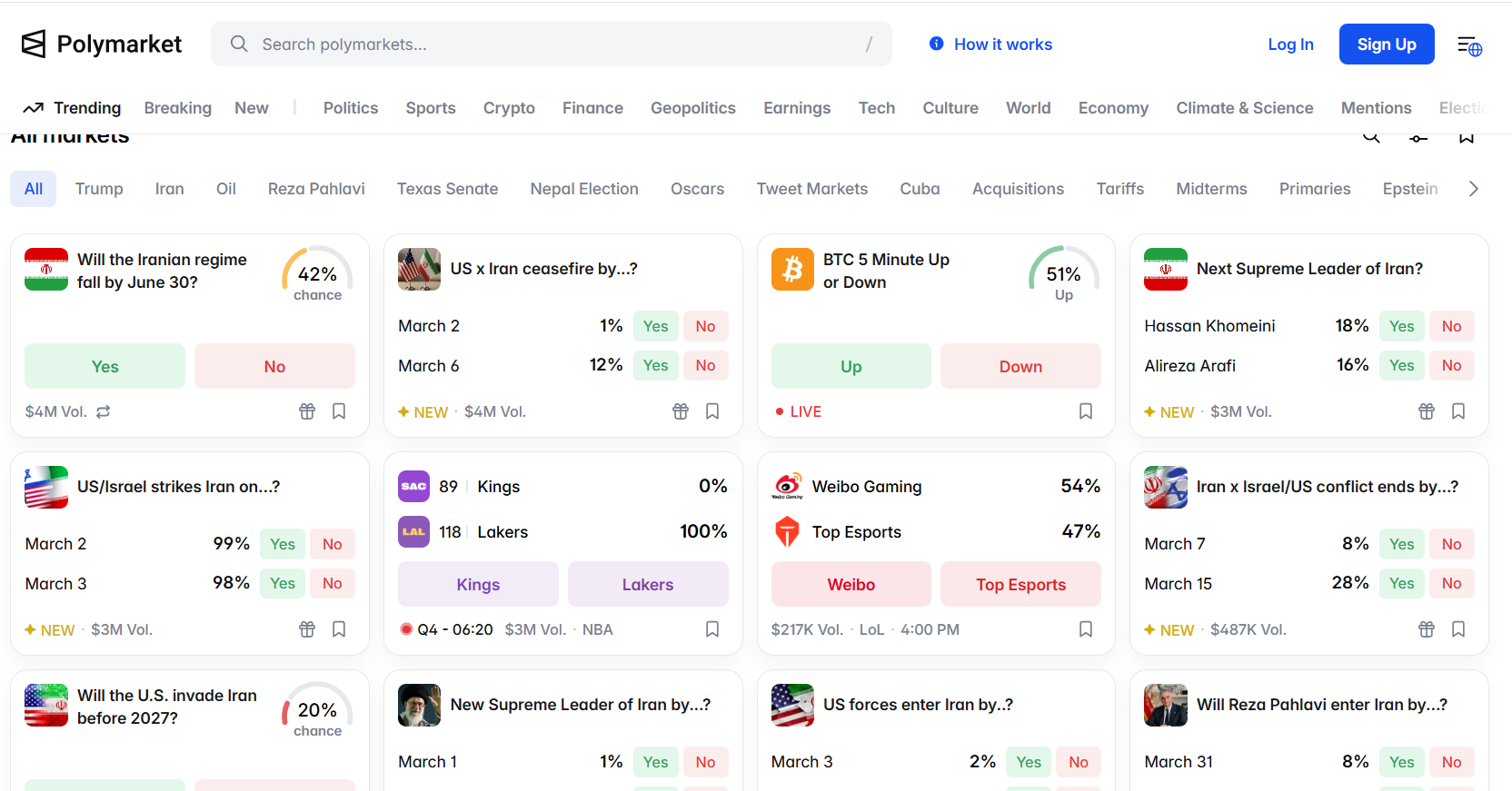
Recent geopolitical tensions involving the United States, Israel, and Iran have driven record trading volume on Polymarket, with some conflict-related markets surpassing $15 million+ in lifetime volume as traders position around outcomes like ceasefire timelines and escalation probabilities. For example, a market asking whether a U.S.–Iran ceasefire would occur by March 31, 2026 saw its implied probability swing from below 45% to over 64% within days of shifting diplomatic signals — a reflection of how quickly crowd beliefs update with real world news.
This surge isn’t limited to geopolitics either. Events tied to FIFA World Cup 2026 — including qualification questions and host nation scenarios — have also seen noticeable trading spikes, with some markets attracting hundreds of thousands in volume during peak global attention windows.
When global risk intersects with major cultural moments, Polymarket activity typically accelerates as participants seek real-time probability signals about what’s most likely to happen next.

Source: theblock.co
What Markets Can You Trade on Polymarket?
Polymarket markets cover real-world events across politics, sports, crypto, macroeconomics, culture, and breaking news—focusing on outcomes that are clearly defined and verifiable. Liquidity typically concentrates on high-attention topics where information flows quickly and resolution criteria are straightforward.
Some market categories appear most often as follows:
| Category | Example market question | Liquidity tendency | Beginner note |
| Elections | “Will candidate Trump win?” | Often high during major cycles | Read exact jurisdiction + date |
| Sports | “Will Team Spain win the final?” | Medium to high on major events | Check market close time |
| Crypto/finance | “Will BTC close above 70.000$ by date?” | High when volatility spikes | Beware late repricing near expiry |
| Macroeconomics | “Will CPI be above X?” | Medium around data releases | Confirm the data source used |
| Culture | “Will X win an award?” | Varies widely | Higher ambiguity risk sometimes |
| Policy/news | “Will a bill pass by date?” | Varies | Wording clarity is everything |
| Weather | “Will hurricane make landfall?” | Often thinner | Expect bigger spreads/slippage |
Source: Polymarket.com
What Fees Does Polymarket Charge?
Polymarket fees are not a single fixed charge—they are the total cost of executing a trade, including gas, bridging, and spread/slippage. Instead of charging a clear trading fee, Polymarket’s costs depend on how you move funds, how liquid the market is, and how efficiently your orders are executed.
- Network gas: Polymarket runs mainly on Polygon. A typical transaction costs ~0.0003–0.0012 MATIC (~$0.02–$0.10). During busy periods, approvals plus trade execution may total ~$0.30–$0.50.
- Bridging costs: Moving USDC from Ethereum or another chain to Polygon may cost ~$10–$30 depending on network conditions. Some bridges add a 0.1–0.3% protocol fee. Transfers usually take 2–15 minutes.
- Spread and slippage: Bid–ask spread is often the biggest hidden cost. High-liquidity markets may show 0.2–0.5% spreads. Thin markets can widen to 1–3% or more, increasing your effective entry price.
- Withdrawal path costs: After settlement, transferring USDC to another chain, exchange, or fiat off-ramp may trigger additional gas or bridging fees. Always factor this into your total cost plan
What are the Risks of Polymarket?
Prediction markets are influenced by liquidity, market sentiment, and real-world events, meaning prices can move quickly and outcomes are uncertain.
-
Market volatility
Prices in prediction markets change rapidly as new information enters the market.
-
Liquidity risk
Some markets have limited trading volume, which can cause slippage or difficulty exiting positions.
-
Event resolution risk
Each market has specific rules for how outcomes are determined. Misunderstanding settlement criteria can lead to unexpected results.
-
Regulatory uncertainty
Prediction markets operate under different legal frameworks depending on jurisdiction.
-
Overconfidence bias
Many beginners assume their personal opinion predicts the outcome better than the market consensus.
Is Polymarket Legal Where You Live?
Legality depends on jurisdiction, and availability can change over time. Some regions restrict or prohibit prediction markets, while others allow access under specific conditions. So, you should verify local rules and platform terms before participating.
| Checkpoint | What to look for | Why it matters |
| Geo-restrictions | Is your country/region blocked? | Access may be prohibited |
| Local regulation stance | Gambling/derivatives rules | Defines what’s permitted |
| Platform terms | Eligibility language | You must follow the terms |
| KYC requirements | If any apply via your route | Impacts onboarding and privacy |
| Tax awareness | Reporting rules for gains | Avoid future compliance surprises |
What should I do if access is restricted?
If Polymarket is not legally available in your region:
- Do not attempt VPN or technical workarounds.
- Use prediction markets strictly as an educational case study.
- Explore compliant local alternatives regulated in your jurisdiction.
- Focus on understanding implied probability, liquidity dynamics, and risk management principles before deploying capital elsewhere.
Compliance is not just about avoiding penalties — it protects your capital and long-term access to markets.
What are Beginner Mistakes on Polymarket?
Beginner mistakes on Polymarket usually come from misunderstanding probability pricing, liquidity, and how markets resolve—leading to poor entries, exits, and risk control.
- Treating price as certainty: A $0.70 price means ~70% probability, not a guaranteed outcome.
- Ignoring liquidity: Low-volume markets can cause large spreads and slippage when entering or exiting.
- Not reading resolution rules: Misunderstanding how an event is judged can lead to unexpected losses.
- Holding until resolution blindly: Many beginners forget they can sell early and manage risk dynamically.
- Overbetting based on opinion: Personal bias often overrides market consensus, leading to poor trades.
- Ignoring total costs: Gas, bridging, and spread can significantly affect real profit.
- Chasing late moves: Entering after big price swings often results in bad risk-reward.
Most mistakes come from treating Polymarket like gambling instead of a probability trading market.
How to Access Polymarket via Bitget Wallet?
For prediction markets like Polymarket, the most relevant wallet features are those that support self-custody, stablecoin management, and easy access to Web3 applications. These capabilities help users interact with markets securely while maintaining control over their funds.
Key aspects to highlight:
-
Self-custody:
With Bitget Wallet, users control their private keys rather than relying on a centralized platform.
-
Web3 access:
A Web3 wallet connects directly to dApps like Polymarket, enabling on-chain prediction market trading.
-
Stablecoin management:
Markets often settle in USD Coin, so wallets that support stablecoin transfers across networks help users manage liquidity efficiently.
In practice, a self-custody wallet functions as the access layer for interacting with decentralized prediction markets while keeping assets under user control.
Related Reading on Polymarket Trading
Polymarket is one of the most active decentralized prediction market platforms, allowing users to trade Yes-No contracts on politics, macro events, sports, and breaking news. If you're exploring how Polymarket works and how traders approach liquidity and strategy, these guides provide deeper insights.
🔹 Polymarket Platform Overview
- What Is Polymarket: A Beginner’s Guide to Trading Decentralized Prediction Markets
- Top Polymarket Projects Ranked by Liquidity, Active Users, and Market Impact
- Polymarket Trading Strategies: How to Make Money on Polymarket?
- Kalshi vs Polymarket: Who Is the True King of the Prediction Market in 2026?
🔹 About Polymarket Token
- What Is Polymarket Token (POLY): The Blockchain-Based Prediction Market Backed by ICE and NYSE
- Polymarket Airdrop Guide: How to Participate and Claim $POLY Rewards?
- How to Buy POLY in 2026: A Beginner’s Step-by-Step Guide to Polymarket Token
- Polymarket Listing Launch Date: What Investors Should Know Before $POLY Goes Live
🔹 About Prediction Markets
- What Is a Prediction Market in Crypto and How Blockchain-Based Prediction Markets Work
- Types of Prediction Market: Real Money, Play Money, and Decentralized Systems
- How to Trade Crypto Prediction Markets?
- What Is a Yes No Market: How Investors Trade Probabilities Using Yes-or-No Contracts
- How to Trade on Yes-No Market: A Practical Guide to Binary Prediction Trading
Sign up Bitget Wallet now - grab your $2 bonus!
Conclusion
What Is Polymarket is best understood as a decentralized prediction market where “yes/no” shares trade like probabilities, settle in USDC, and update in real time as information changes. For beginners, the edge comes from clarity: understand implied probability, prioritize liquid markets, read settlement rules first, and treat price as a signal—not certainty.
If you want a beginner-friendly way to connect to Web3 apps like Polymarket while managing stablecoins under full self-custody, Bitget Wallet streamlines the process. With secure asset management, cross-chain access, built-in Web3 browsing, and strong security controls, Bitget Wallet provides a practical gateway to prediction markets and thousands of other dApps.
Download Bitget Wallet today to participate in Polymarket and explore the broader on-chain ecosystem with confidence.
FAQs
1. What Is Polymarket?
Polymarket is a decentralized prediction market where you trade “Yes” or “No” shares on real-world outcomes. Prices generally reflect the market’s implied probability, and winning shares settle at $1 in USDC.
2. How Does Polymarket Work?
You choose a market, buy or sell shares priced from $0.01 to $1.00, and you can exit before resolution. After the event, an oracle-based system verifies the outcome and positions settle in USDC, often on Polygon for low-cost execution.
4. How to Access Polymarket?
Bitget Wallet can help you connect to Polymarket through an in-app browser, and reduce mistakes with security habits like approval review and post-trade permission cleanup.
Risk Disclosure
Please be aware that cryptocurrency trading involves high market risk. Bitget Wallet is not responsible for any trading losses incurred. Always perform your own research and trade responsibly.