What Are Prediction Odds: A Beginner’s Guide to Understanding Market Probability
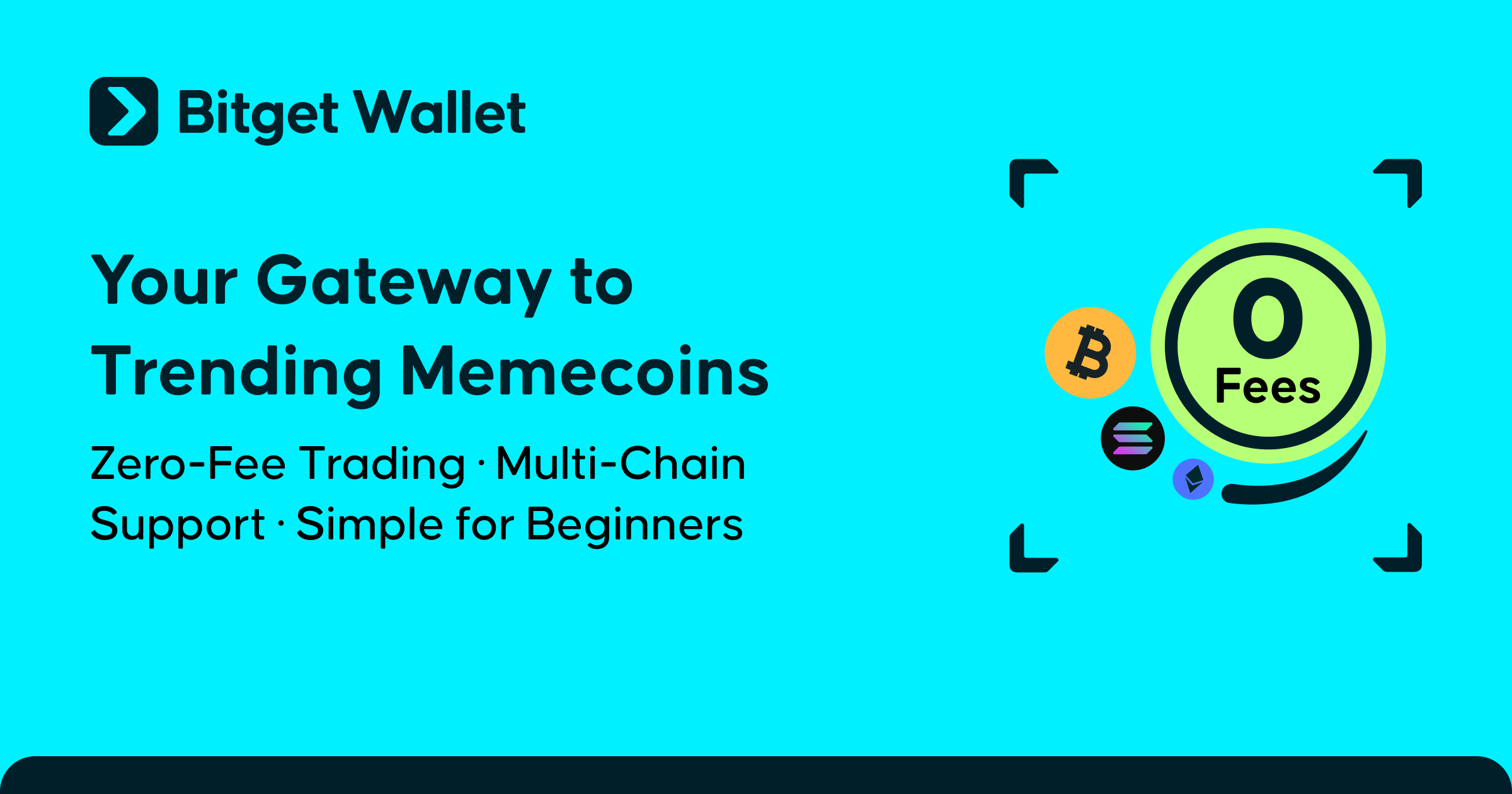
What Are Prediction Odds are market-based signals that express the implied probability of an event. In most prediction markets, the price of a contract trades between $0 and $1. Unlike bookmaker odds, prediction odds are shown as tradable probabilities.
In 2026, prediction odds matter more because people increasingly follow markets tied to geopolitical tension, sports, macro events, and crypto narratives. These markets let users trade expectations rather than company shares. For users exploring Web3 prediction markets, a self-custodial wallet and a stablecoin workflow also matter, which is why tools like Bitget Wallet naturally come into the discussion. In this article, we’ll explain how prediction odds work, how they are calculated, how they differ from betting odds, and how beginners can access crypto prediction markets more safely 2026.
Key Takeaways
- Prediction odds express the market’s implied probability of an event, usually shown through contract prices between $0 and $1.
- Unlike sportsbook odds, prediction odds show probability directly, making them easier to interpret for traders.
- Crypto prediction markets use stablecoins, smart contracts, and Web3 wallets to enable transparent trading and on-chain settlement.
What Are Prediction Odds?
Prediction odds are the market’s estimate of how likely an event is to occur, expressed through price. They turn collective information—news, data, and sentiment—into a probability signal. In most binary markets, a higher price means the market believes the event is more likely to happen.
How to Read a Prediction Odds Price?
The easiest way to understand prediction odds is to remember one idea: price and probability are closely linked.
Most prediction market contracts use a binary structure:
- YES settles at $1.00 if the event happens
- NO settles at $1.00 if the event does not happen
That structure makes reading the market intuitive:
- If a YES contract trades at $0.40, the market is roughly saying there is a 40% probability the event happens.
- If you buy at that price and the event resolves YES, the contract settles at $1.00, so your profit is $0.60.
- If the event resolves NO, your maximum loss is the $0.40 you paid.
A useful beginner reminder is that price reflects collective market belief, not truth. New information can change that belief quickly. Also, YES and NO prices often total about 1, but temporary gaps can appear because of spreads, liquidity conditions, and order book differences.
Prediction Odds and Implied Probability Examples
| Contract Price | Implied Probability | Profit if Correct | Maximum Loss |
| $0.20 | 20% | $0.80 | $0.20 |
| $0.40 | 40% | $0.60 | $0.40 |
| $0.65 | 65% | $0.35 | $0.65 |
| $0.75 | 75% | $0.25 | $0.75 |
Source: newyorkcityservers.com
How Are Prediction Odds Calculated in Real Markets?
In real prediction markets, odds are not set by a bookmaker. They are calculated through market price. In most binary markets, a contract settles at $1 if the outcome happens and $0 if it does not. Because of that structure, the current trading price usually works like implied probability.
A simple way to read it is:
- Prediction odds ≈ contract price × 100
- if a YES share trades at $0.35, the market is implying about a 35% chance
- if the price rises to $0.65, the market is implying about a 65% chance
This price changes because of supply and demand. When more traders want to buy YES, the price goes up, so the implied probability rises. When more traders sell YES or buy NO, the price falls, so the implied probability drops.
For example, imagine a market asking: Will Bitcoin reach $100,000 this year?
- early in the week, the YES price is $0.40 → about 40% probability
- positive news appears
- more traders start buying YES
- the price moves to $0.58 → about 58% probability
The event itself has not happened yet. What changed is only the market’s estimate. That is how prediction odds are calculated in real markets: price becomes probability, and price moves as traders react to new information.
| Market Driver | What Happens to Odds? | Why It Matters |
| More YES buying | Odds rise | Higher perceived probability |
| More NO buying | Odds fall | Lower perceived probability |
| Tight bid-ask spread | Better price efficiency | Lower slippage |
| Breaking news | Fast repricing | Markets update in real time |
| Thin liquidity | Sharper price swings | Price may be less reliable |
How Do Prediction Odds Compare With Betting Odds?
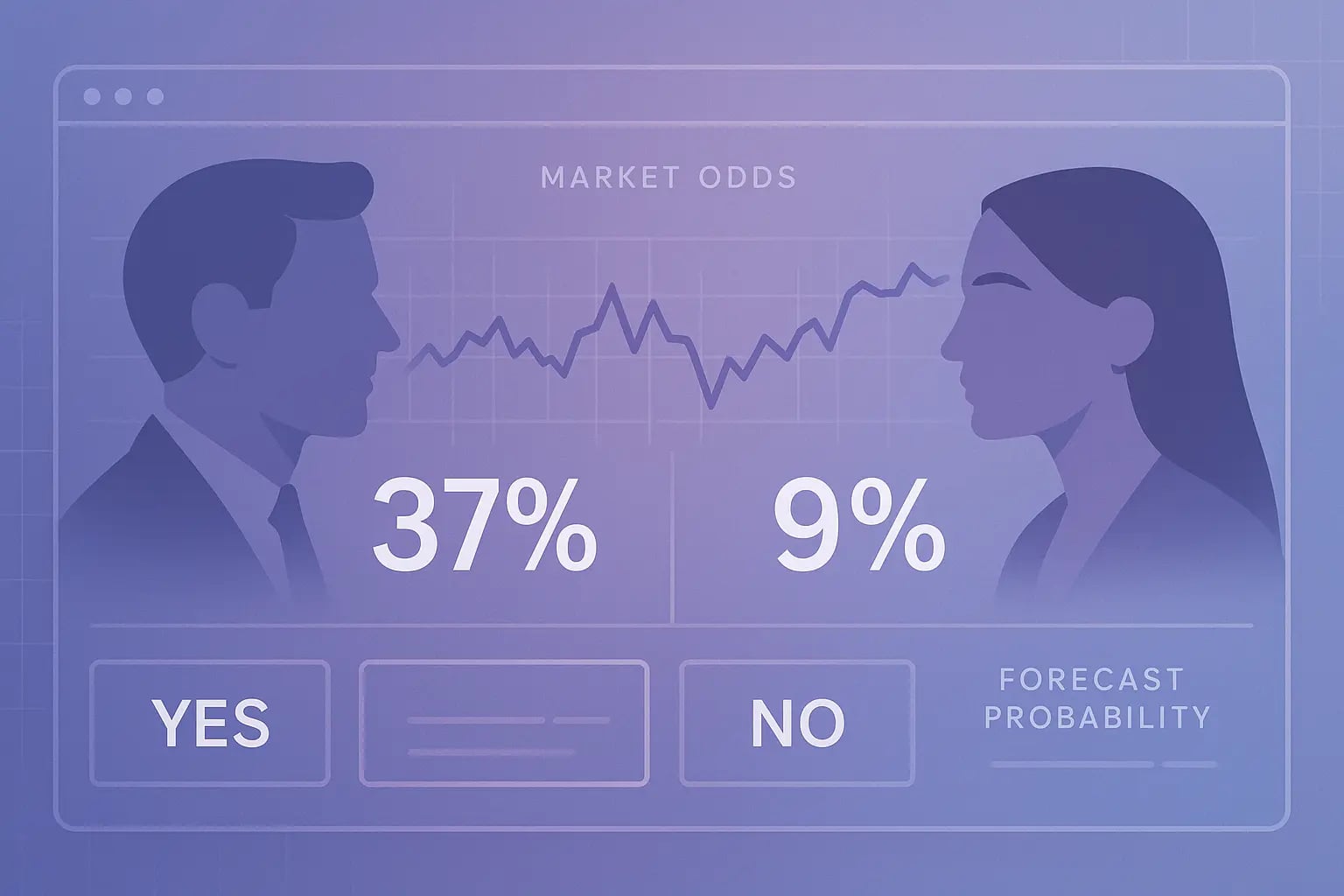
Prediction odds and betting odds both attempt to express the likelihood of an event. The key difference is how that probability is presented. Prediction markets typically show probability directly through contract price, while sportsbooks express it through specific odds formats that must be interpreted or converted.
Understanding the structure of each system makes it easier to compare signals across markets and evaluate how probability is being priced.
Source: ivn.us
1. American Odds
American odds — often called moneyline odds — are the most widely used betting format in U.S. sportsbooks. Instead of showing probability directly, they describe the potential profit relative to a standard stake.
This format uses positive and negative numbers to indicate whether a team or outcome is considered an underdog or a favorite.
- Positive odds (+) indicate how much profit you would win from a $100 bet.
- Negative odds (-) indicate how much money you must stake to win $100.
In practice, this means larger positive numbers represent lower probability outcomes, while negative numbers indicate events the bookmaker considers more likely.
Example
| Odds | Meaning |
| +200 | Bet $100 → win $200 profit |
| -150 | Bet $150 → win $100 profit |
Because American odds emphasize payouts rather than probability, traders often convert them into implied probability when comparing them with market-based pricing signals such as prediction odds.
2. Decimal Odds
Decimal odds are widely used across Europe, Canada, Australia, and many international sportsbooks. This format expresses the total return from a bet, including the original stake.
Instead of separating stake and profit, decimal odds combine them into a single multiplier, which makes calculations easier for many bettors.
- The decimal number represents the amount returned for every unit wagered.
- To calculate potential returns, simply multiply the stake by the odds.
Example
| Odds | Meaning |
| 2.50 | Bet $100 → receive $250 total payout |
| 1.80 | Bet $100 → receive $180 total payout |
In this format, higher decimal numbers represent outcomes that are considered less likely, while lower numbers indicate favorites. Although decimal odds are easier to read than moneyline odds, they still do not display probability directly, meaning users must convert them into implied probability for deeper analysis.
3. Fractional Odds
Fractional odds are one of the oldest betting formats and remain common in UK sportsbooks, horse racing markets, and some traditional bookmakers.
This format expresses the ratio of profit relative to the stake, written as a fraction such as 5/1 or 3/2. The first number represents the profit, while the second number represents the stake.
Example
| Meaning | |
| 5/1 | Bet $100 → win $500 profit |
| 3/2 | Bet $100 → win $150 profit |
Fractional odds emphasize the profit potential, which is why they are traditionally favored in sports like horse racing.
However, like other sportsbook formats, the probability of the event is not shown directly. Bettors usually need to convert the fraction into decimal or percentage form to estimate the implied probability.

Source: fplgameweek.com
Prediction Odds vs Betting Odds Comparison
| Comparison Factor | Prediction Markets | Sports Betting |
| Pricing Source | Trader-driven market | Bookmaker-set odds |
| Main Format | Contract price as probability | Moneyline, decimal, fractional |
| Built-in House Edge | Usually no traditional vig | Yes, bookmaker margin |
| Exit Before Resolution | Often possible by selling | Usually limited |
| Transparency | Order books may be visible | Demand is not usually visible |
Based on the table, it's easy to see that Prediction odds show probability directly through price, making them easier to interpret than betting formats like American, decimal, or fractional odds. This clarity is why prediction markets often resemble financial markets.
How Do Prediction Odds Work in Crypto Prediction Markets?
Prediction odds work in crypto prediction markets by using the price of a YES or NO contract to represent the market’s estimated probability of an event happening. Traders use stablecoins to buy these contracts on blockchain-based platforms, where smart contracts hold funds and automatically manage payouts. When the event resolves, an oracle provides the outcome and the contract settles on-chain, making the pricing and settlement process transparent and automated.
What Makes Crypto Prediction Markets Different From Traditional Platforms?
Crypto prediction markets extend the concept of prediction odds into the Web3 environment. Instead of relying on a centralized bookmaker or exchange, these platforms use blockchain infrastructure to run the entire market process.
Key differences include:
-
Blockchain-based markets:
Trades are recorded on a blockchain, creating a transparent ledger of transactions and pricing activity.
-
Smart-contract execution:
Automated programs manage escrow, order execution, and payouts without manual intervention.
-
On-chain settlement:
When an event resolves, the smart contract distributes funds automatically according to the contract rules.
-
Wallet-based access:
Users typically connect a Web3 wallet rather than creating a traditional account. This keeps custody of funds in the user's control.
-
Public transparency:
Market activity, liquidity, and trade history can often be viewed on-chain.
How Do YES and NO Contracts Settle On-Chain?
In most crypto prediction markets, contracts follow a binary structure: traders choose between a YES outcome or a NO outcome. Each contract represents the probability that a specific event will occur.
The settlement logic is straightforward:
- YES contracts: Pay $1 if the predicted event happens.
- NO contracts: Pay $1 if the event does not happen.
- Losing contracts: Settle at $0.
All funds used in these trades are typically held in stablecoin collateral within the smart contract. When the event outcome becomes known, an oracle sends the result to the blockchain, triggering automatic settlement. Traders then receive their payouts directly in their connected wallet.
Crypto Prediction Market Mechanics
| Element | Role in the Market |
| Stablecoin | Used for trading and settlement |
| Smart contract | Handles escrow and payout logic |
| Oracle | Supplies event outcome data |
| YES contract | Pays $1 if event happens |
| NO contract | Pays $1 if event fails |
How Do Traders Use Prediction Odds to Find Opportunities?
Traders use prediction odds to find opportunities in four main ways: identifying mispriced probabilities, exploiting arbitrage price gaps, hedging existing risk exposure, and evaluating liquidity signals. By comparing market-implied probability with their own analysis, traders can spot situations where prices appear too high or too low.
Bellow's how each of these methods works in practice.
1. Mispriced Probability Gaps
The most common way traders find opportunities is by identifying a gap between the market’s implied probability and their own estimate.
In many prediction markets, the contract price directly reflects probability. For example, if a contract trades at $0.40, the market is implying a 40% chance that the event will occur.
| Signal | Value |
| Market price | $0.40 (40%) |
| Trader estimate | 50% probability |
| Potential edge | 10% probability gap |
If a trader believes the real probability is closer to 50%, the contract may be undervalued. Buying at $0.40 means paying for a 40% probability while believing the true likelihood is higher. The opportunity comes from this difference.
The key idea is that traders are not searching for certainty. They are looking for prices that seem misaligned with probability.
2. Arbitrage Pricing Differences
Opportunities can also appear when prices become inconsistent within the same market or across platforms.
A simple example occurs when the price of YES and NO shares temporarily creates a pricing gap.
| Contract | Price |
| YES share | $0.45 |
| NO share | $0.52 |
| Total cost | $0.97 |
| Settlement value | $1.00 |
If a trader buys both contracts for $0.97, one outcome must settle at $1.00, creating a potential 3% spread before fees.
A similar situation can occur across platforms. If one venue prices an event at 55% probability while another shows 60%, traders may buy the cheaper contract and sell the higher-priced one to capture the difference.
3. Hedging Real-World Risk
Prediction odds are not only used to find profit opportunities. They can also help traders reduce risk from other exposures.
- For example:
- A crypto investor who holds a large Bitcoin position might buy a prediction contract such as “Bitcoin below $40,000 by year-end.”
- If the market drops, the investor’s portfolio loses value, but the prediction contract pays out and partially offsets the loss.
In this way, prediction markets can act as a tool for managing uncertainty around major events such as sports outcomes, political decisions, or crypto market milestones.
4. Liquidity-Based Price Signals
Before trusting prediction odds as an opportunity, traders also evaluate market liquidity.
- In thin markets, a single large order can move the price dramatically. For example, a large trade could push an implied probability from 40% to 55% within minutes. In this case, the price might reflect one trader’s view rather than a broad market consensus.
- By contrast, markets with deeper liquidity usually produce more reliable signals because many participants contribute information. Prices adjust more gradually as new data appears.
For this reason, experienced traders treat prediction odds as a signal of collective belief, not an objective truth. The opportunity lies in interpreting that signal better than the rest of the market.
What Does a Real Prediction Odds Example Look Like?
A real example is the easiest way to understand what prediction odds mean in practice. In most prediction markets, the contract price represents the probability that an event will happen. By looking at the entry price, implied probability, and final payout, beginners can clearly see how prediction odds translate into risk and potential profit.
Example — Buying a YES Contract at $0.40
Imagine a prediction market asking the question:
“Will Bitcoin exceed $100,000 by December 2026?”
In the market, the YES contract is currently trading at $0.40.
| Item | Value |
| Contract price | $0.40 |
| Implied probability | 40% |
| Settlement value if correct | $1.00 |
| Potential profit | $0.60 |
| Maximum loss | $0.40 |
Here is how the trade works step by step.
- A trader buys a YES contract at $0.40, paying $0.40 to enter the position.
- The market price implies the event has about a 40% probability of happening.
- If Bitcoin exceeds $100,000, the contract settles at $1.00.
- The trader earns $0.60 profit ($1.00 − $0.40).
- If Bitcoin does not exceed $100,000, the contract resolves to $0, meaning the trader loses the $0.40 entry cost.
This simple scenario shows how prediction odds translate directly into probability and payout:
- Lower price contracts offer higher potential return but lower probability.
- Higher price contracts imply a higher probability but smaller upside.
In real prediction markets, traders continuously buy and sell these contracts, causing prices—and therefore prediction odds—to change as new information enters the market.
What Risks Should Beginners Understand Before Using Prediction Odds?
Prediction odds help estimate probability, but they are not perfect signals. Prices reflect trader expectations and can change quickly as new information appears. Before trading, beginners should understand several risks of prediction markets trading.
Key Risks to Know
- Market Mispricing – Prediction odds reflect market belief, not guaranteed outcomes.
- Liquidity Risk – Low trading volume can cause slippage or wide spreads.
- Settlement Risk – Outcomes depend on predefined rules that may be misunderstood.
- Volatility – Odds can change quickly as news and sentiment shift.
- Psychological Bias – Overconfidence and emotional trading can lead to poor decisions.
- Regulatory Limits – Some jurisdictions restrict access to prediction markets.
Understanding these risks of prediction markets trading helps beginners treat prediction odds as signals, not certainty.
How Do Prediction Odds Change Over Time?
Prediction odds are not fixed. In most prediction markets, prices continuously update as new information, trader activity, and liquidity enter the market. This means the implied probability of an event can move significantly before the final outcome is known.
Why Do Odds Move Before the Event Even Happens?
Prediction odds change because markets constantly reprice expectations. Even though the event has not resolved yet, traders adjust their positions as new information appears.
Common factors that move prediction odds include:
- Breaking headlines that change how likely an outcome appears
- Data releases, such as economic indicators or election polls
- Order flow, when many traders buy or sell one side of the contract
- Shifts in sentiment, where the overall market mood becomes more optimistic or pessimistic
In other words, when prediction odds move, it doesn’t mean the event outcome has changed — it simply means the market’s belief about the probability has changed.
How Do High-Profile Events Create Faster Odds Movement?
High-attention events usually see faster and more frequent price updates.
Examples include:
- Geopolitical tensions – During periods of US–Iran escalation, prediction markets asking questions like “Will the U.S. enter a direct conflict in 2026?” can move quickly after major headlines, sometimes shifting from around 20% to 35% within hours as traders react to new developments.
- Major sports finals – In football finals, odds can change instantly if a key player is injured. A team priced at 60% win probability may drop closer to 50% once traders reassess the match outcome.
- Crypto milestone markets – In markets like “Will ETH reach $2100 this month?”, odds might start near 40% but jump above 60% if Ethereum rallies after strong market news or institutional inflows.
These markets reprice quickly because they attract:
- More traders participating
- Deeper order books
- Stronger and faster information flow
When many participants react to the same news at the same time, prediction odds can adjust within minutes.
What Does Price Stability or Volatility Reveal About Market Quality?
The way prediction odds move can also reveal something about the quality of the market.
- Stable odds in a liquid market often indicate strong consensus among traders.
- Sudden large price jumps in a thin market may simply reflect low liquidity rather than meaningful new information.
For this reason, experienced traders usually check trading volume and order-book depth before interpreting a price change.
A well-functioning prediction market tends to combine active participation, steady liquidity, and gradual price discovery, which helps prediction odds reflect collective expectations more accurately.
Which Platforms Let Users Trade Prediction Odds?
Several platforms allow users to trade prediction odds, but the best choice depends on factors such as regulation, market access, liquidity, settlement method, and user workflow. Some platforms are crypto-native and on-chain, while others operate as regulated financial exchanges using fiat currency. Understanding these differences helps users choose the environment that fits their needs.
1. Polymarket

Source: coinmarketcap.com
Polymarket is one of the most widely used crypto-native prediction markets, and its growth has accelerated rapidly in recent years. The platform has recorded around $425 million in daily trading volume, with more than $7 billion traded in February 2026 alone, reflecting rising demand for crypto-based prediction markets.
Polymarket operates on blockchain infrastructure and allows users to trade YES/NO contracts on real-world events such as politics, crypto prices, or global news.
Key characteristics include:
- Crypto settlement: Trades typically settle using stablecoins such as USDC.
- Wallet connection: Users interact through Bitget Wallet rather than a traditional brokerage account.
- On-chain transparency: Market activity and pricing can be publicly inspected.
- Global participation model: Many users access markets through decentralized interfaces depending on regional rules.
Because contracts trade between $0 and $1, Polymarket makes it easy to read prediction odds as implied probability.
2. Kalshi

Source: coinmarketcap.com
Kalshi represents a different model: a regulated event-contract exchange in the United States. The platform has expanded quickly, reaching over 2 million users and generating billions of dollars in event-contract trading during major news and economic events.
Unlike crypto prediction platforms, Kalshi operates more like a financial exchange built within the traditional regulatory system.
Key characteristics include:
- Regulated framework: The platform is approved by the U.S. Commodity Futures Trading Commission (CFTC).
- Fiat settlement: Users deposit and withdraw funds through bank transfers and other fiat payment methods.
- Event contracts: Markets settle at $1 or $0 depending on the final outcome.
- Compliance requirements: Identity verification and regional restrictions apply.
Kalshi commonly lists markets tied to economic data releases, elections, weather outcomes, and other measurable events, positioning itself as a regulated alternative to crypto-native prediction markets.
3. Other Platforms
Beyond these two well-known examples, the prediction market ecosystem includes several other approaches.
Some platforms operate as fully decentralized protocols, where markets are created and traded directly through smart contracts. Others are hybrid platforms, combining Web3 infrastructure with more structured trading interfaces.
These platforms generally differ along several dimensions:
- Crypto-native vs fiat-based trading
- On-chain transparency vs centralized matching systems
- Wallet-connected access vs account-based onboarding
- Global vs region-restricted participation
Rather than focusing on a single “best” platform, experienced users typically evaluate liquidity, market depth, fees, and regulatory access before choosing where to trade prediction odds.
How to Access Prediction Markets More Safely With Bitget Wallet?
Bitget Wallet can serve as a practical self-custody gateway to prediction markets, helping users manage USDC, connect to Web3 dApps, and keep control of their own assets instead of relying on a custodial platform.
For many beginners, the advantage is simple: one app to store funds securely, review wallet permissions carefully, and access prediction market platforms with better security habits built in.
Below is a step-by-step guide to getting started more safely.
Step 1: Create a wallet
- If you don't have a wallet, download Bitget Wallet app now.
- Register with your phone number or email, verify quickly and you can use it right away.
Step 2: Deposit money into your wallet
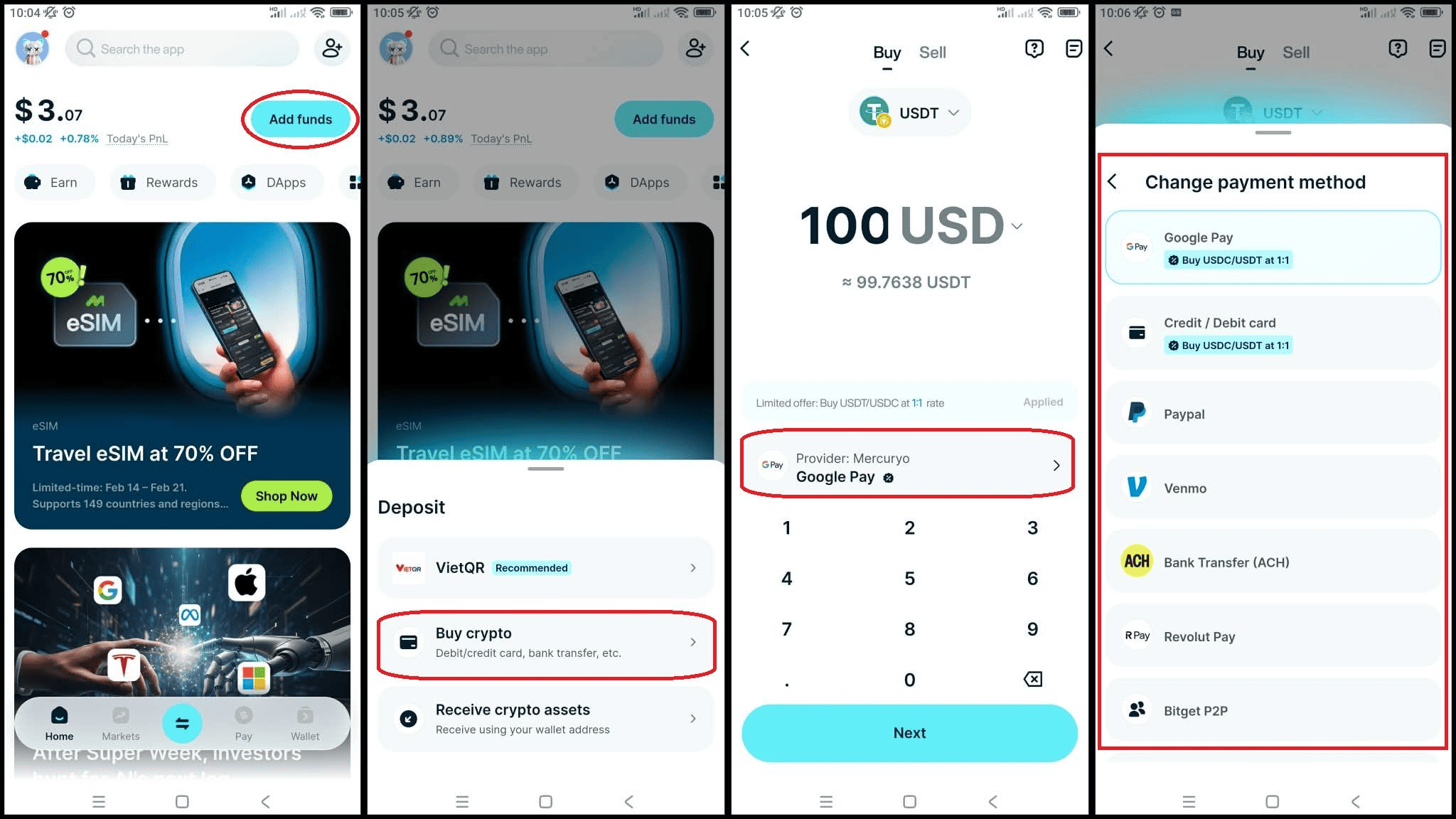
Once you have finished your wallet, you just need to deposit money into it. You can:
- Transfer coins from other wallets: Send BTC, ETH or any coin you have from an external wallet.
- Buy directly with a card: Use a bank card or credit card to buy USDT or ETH right in the app and then exchange it for USDC.
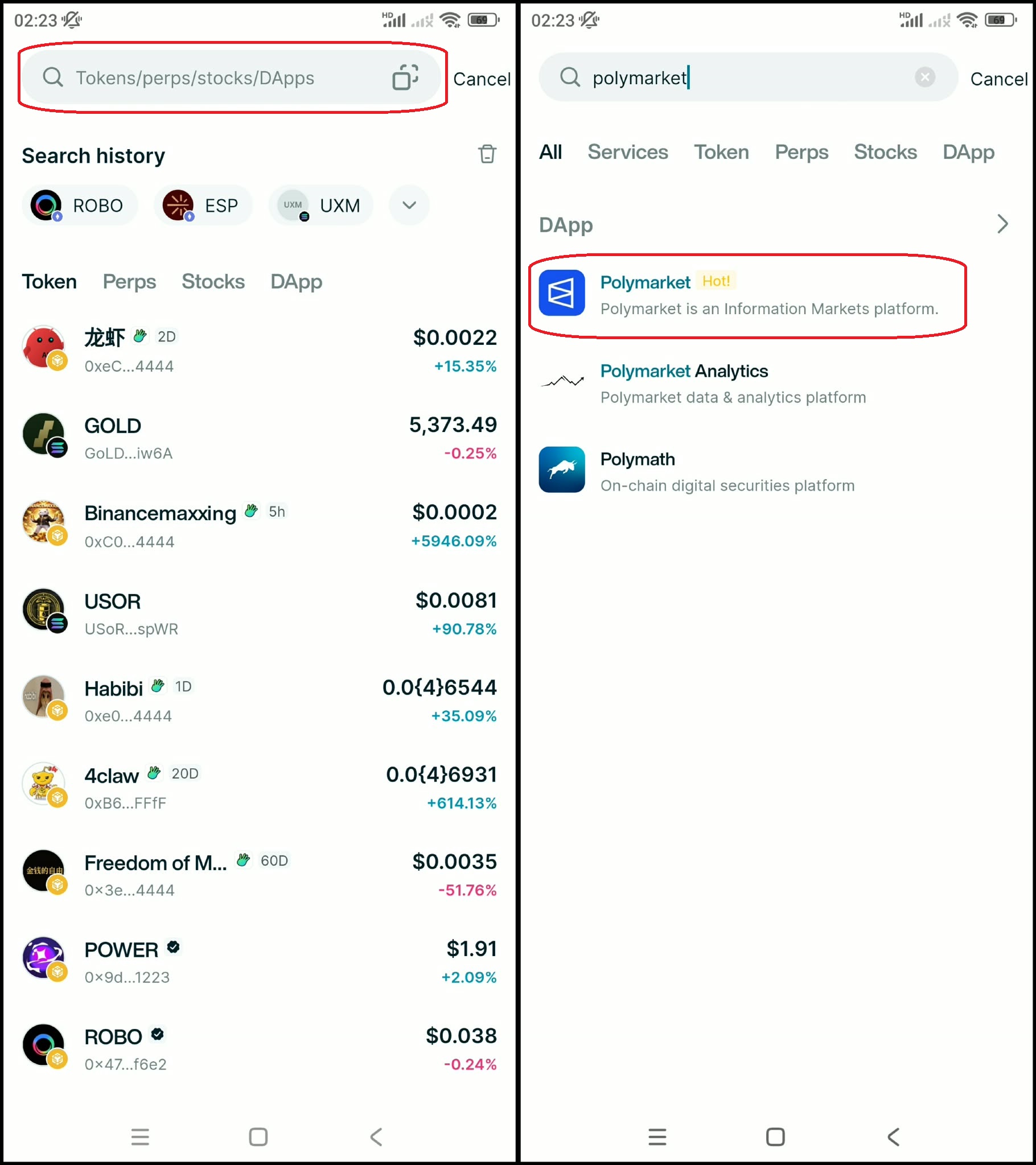
Step 3: Open the Built-in Web3 Browser
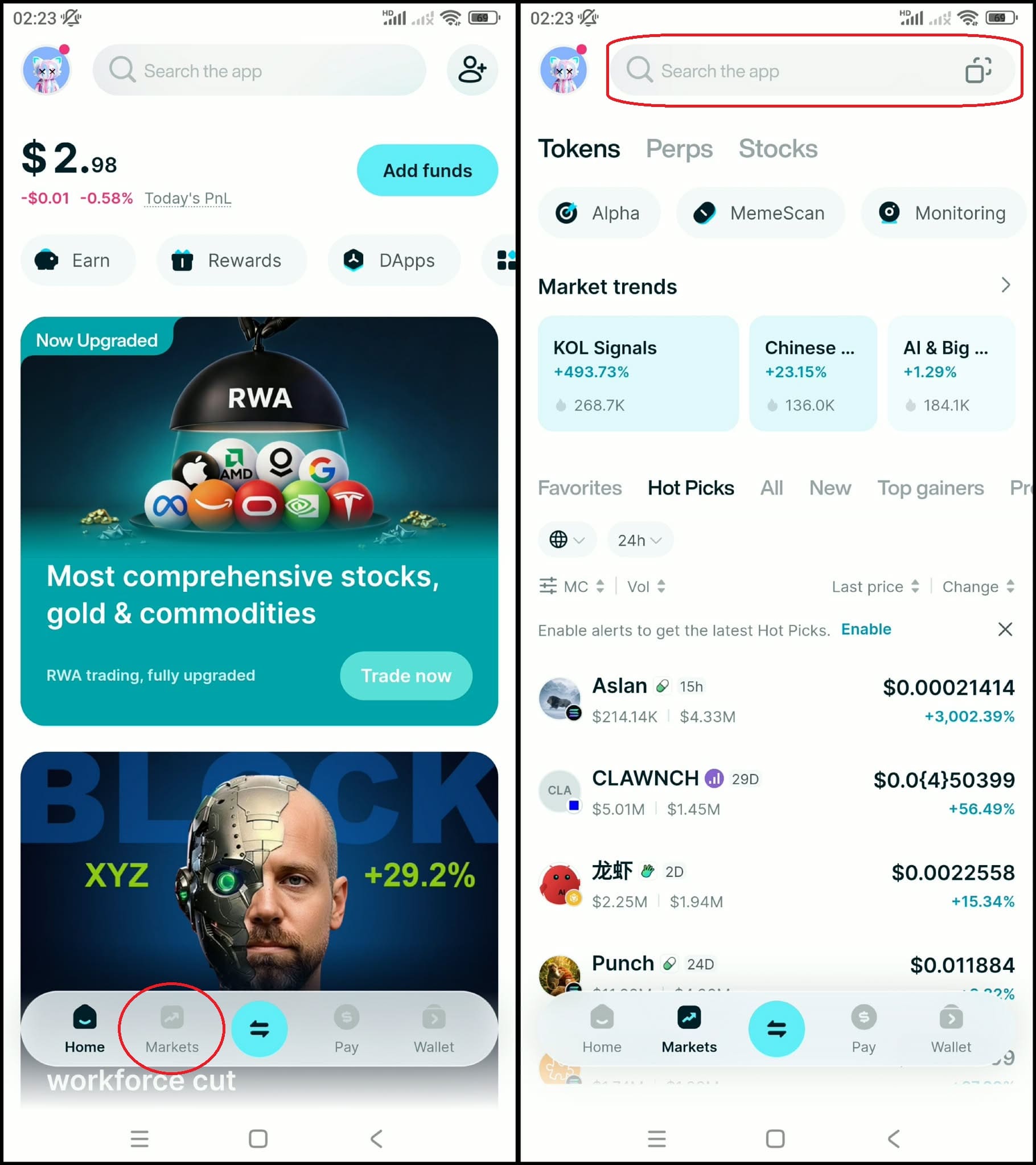
Inside the app, go to the “Markets” section and use the search bar at the top to access Web3 dApps directly.
Step 4: Find PolyMarket
Enter “Polymarket” in the search bar and select it when it appears. This allows you to open the prediction-market interface within the wallet environment.
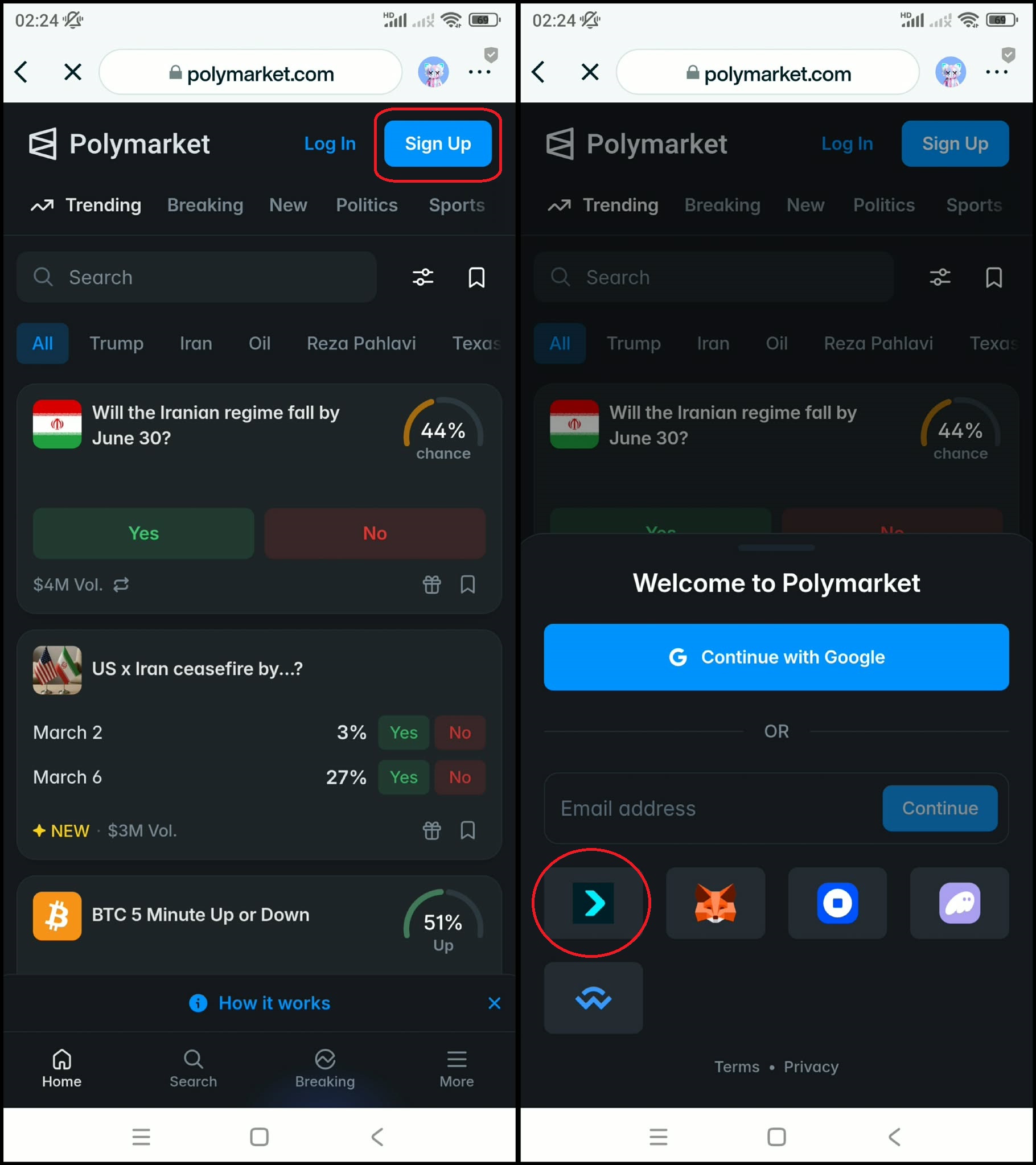
Step 5: Connect Your Wallet
Approve the wallet connection request securely inside the app. Always review the connection prompt before confirming.
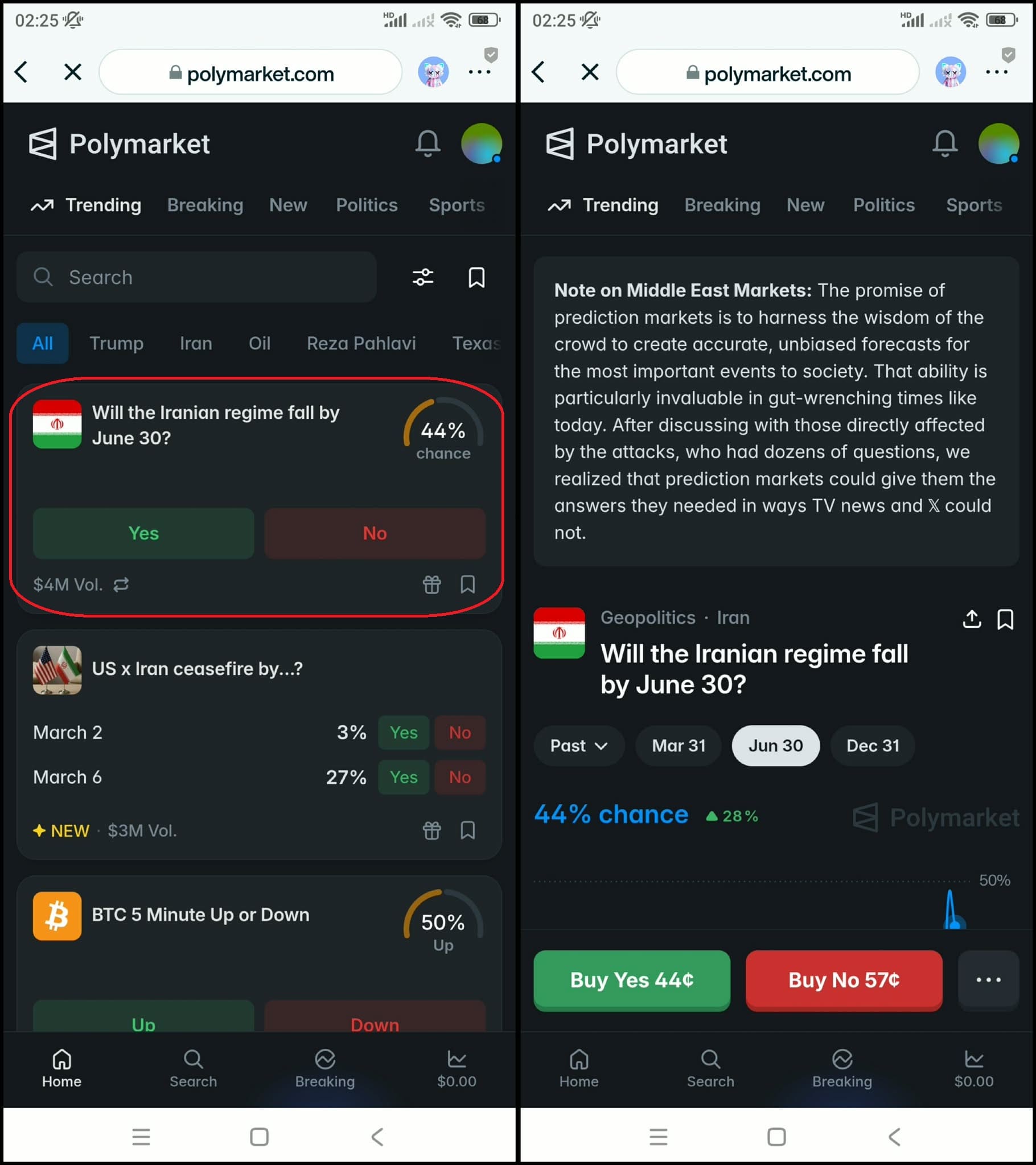
Step 6: Choose a YES/NO Contract
Browse available markets, review contract pricing, implied probability, liquidity depth, and trading fees before entering a position.
Step 7: Execute and Monitor Your Position
Place your trade, track price movements, and manage your exit timing based on liquidity conditions and cost considerations.
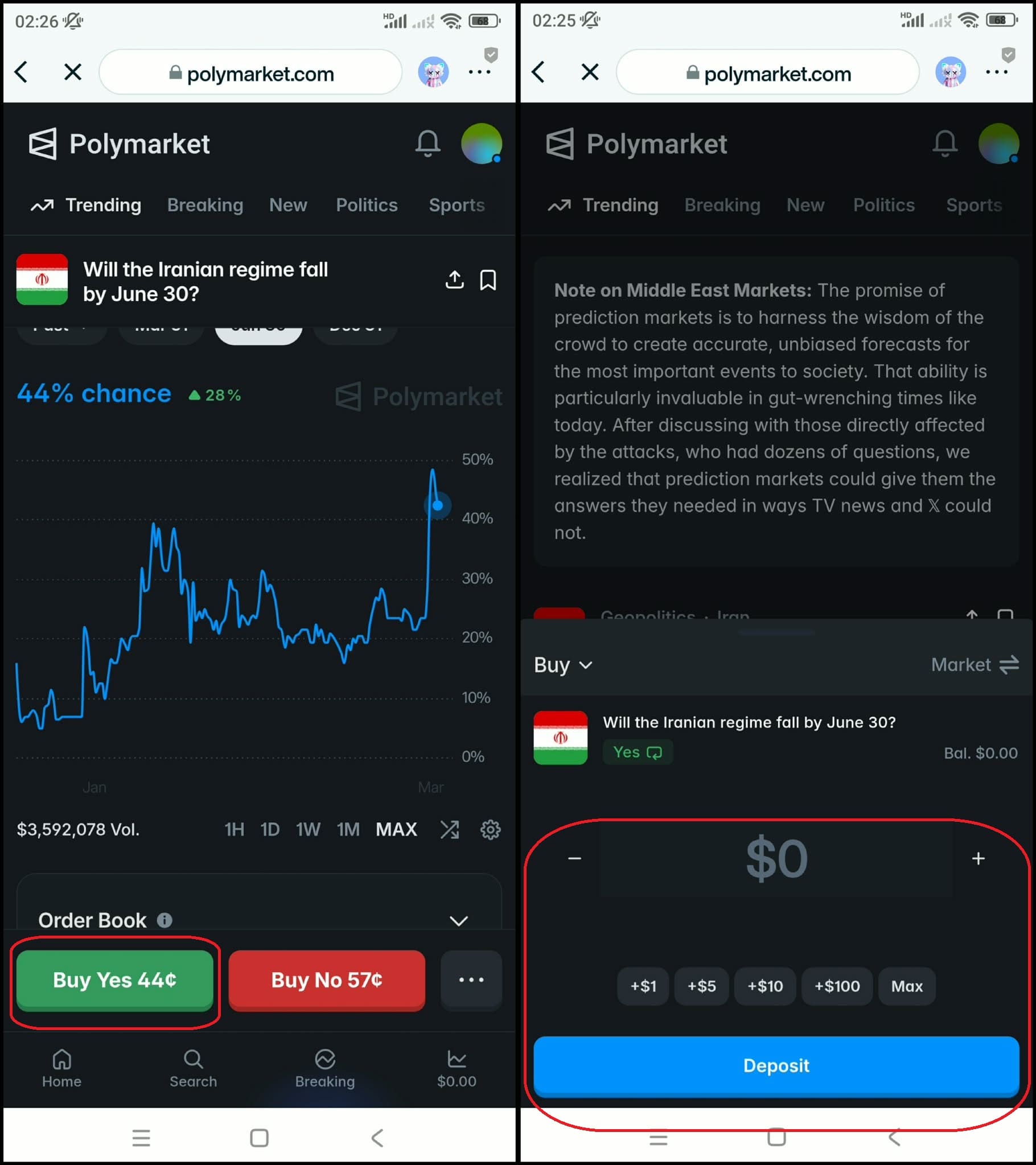
By following these structured steps, you can confidently access on-chain Polymarket markets while retaining full self-custody and control over your assets.
What Extra Utility Can Bitget Wallet Offer Beyond Market Access?
Beyond connecting to prediction markets, Bitget Wallet offers additional tools that make it easier to manage and use crypto across Web3. Users can store and move stablecoins, access on-chain trading, and interact with other applications from the same wallet.
Key utilities include:
- Stablecoin Earn Plus: Earn yield on idle stablecoins, with rates that can reach up to 10% APY depending on market conditions.
- Zero-fee trading on selected assets: Certain memecoins and tokenized RWA U.S. stock products can be traded with zero fees.
- Crypto payment cards: Integration with Mastercard and Visa rails allows users to spend crypto globally through a crypto card with no transaction fees.
These features expand the wallet’s role beyond market access, turning it into a multi-purpose Web3 hub for storing assets, exploring dApps, and managing stablecoins securely.
Related Reading on Prediction Odds
Prediction odds are widely used in prediction markets to estimate the probability of real-world events. From understanding how market prices translate into probability to analyzing odds in major global events, the following guides explore how prediction odds work in theory and in practice.
🔹 Prediction Odds Fundamentals
- What Are Prediction Odds: A Beginner’s Guide to Understanding Market Probability
- How to Read Prediction Odds: A Beginner’s Guide to Market Probability
- Prediction Odds vs Betting Odds: What’s the Difference Between Prediction Markets and Sportsbook Odds?
🔹 Prediction Market Odds
🔹 Event-Specific Prediction Odds
- FIFA World Cup Odds 2026: How to Bet on the Winner
- United States World Cup Prediction Market: Can the Golden Generation Outperform the Odds?
- World Cup Odds 2026: Prediction Market vs Betting
Conclusion
What Are Prediction Odds can be understood as market-implied probabilities that reflect collective expectations about future events. In prediction markets, the contract price itself acts as the probability signal. These odds continuously adjust as new information, participation, and liquidity enter the market. Unlike sportsbook odds, which require conversion from formats like moneyline or decimal, prediction odds display probability directly. For beginners, interpreting these signals also means paying attention to market liquidity, trading fees, and the exact rules that determine how contracts resolve.
Once you understand how prediction odds work, the next step is accessing prediction markets with a structured and secure workflow. Using a self-custody Wallet like Bitget Wallet helps users manage stablecoins, connect to Web3 prediction platforms, and explore markets across multiple chains while keeping control of their assets.
Download Bitget Wallet to manage stablecoins and participate in prediction markets with the most comprehensive control!
Sign up Bitget Wallet now - grab your $2 bonus!
FAQs
1. What Are Prediction Odds?
Prediction odds are the market’s estimate of how likely an event is to occur, expressed through price. They turn collective information—news, data, and sentiment—into a probability signal. In most binary markets, a higher price means the market believes the event is more likely to happen.
2. Are Prediction Odds the Same as Betting Odds?
No. Prediction odds typically show probability directly through contract price. Betting odds, by contrast, use formats such as moneyline, decimal, or fractional odds. These formats focus on payout ratios and usually include a bookmaker margin, which means the implied probability must be calculated separately.
3. Why Do Prediction Odds Move Before the Event Is Resolved?
Prediction odds move because traders update their positions as new information appears. News headlines, data releases, and shifts in sentiment can change how likely an outcome seems. The price movement reflects changing expectations in the market, even though the final event outcome has not yet occurred.
4. Can Prediction Odds Be Wrong?
Yes. Prediction odds represent collective market belief, not guaranteed truth. In markets with low liquidity, strong narratives, or unclear contract wording, prices may temporarily deviate from realistic probabilities. This is why experienced traders treat prediction odds as signals that still require interpretation.
5. Do I Need a Crypto Wallet to Use Crypto Prediction Markets?
For many on-chain prediction markets, a crypto wallet is required to connect and trade. Users typically access these platforms through wallets like Bitget Wallet, which allow them to manage funds, connect to prediction market dApps, and keep full self-custody of their assets while participating in Web3 markets.
Risk Disclosure
Please be aware that cryptocurrency trading involves high market risk. Bitget Wallet is not responsible for any trading losses incurred. Always perform your own research and trade responsibly.