Polymarket Trading Strategies: How to Make Money on Polymarket?

Polymarket Trading Strategies are systematic frameworks designed to exploit probability mispricing in prediction markets rather than speculate on headlines. Unlike traditional betting models that rely on opinion or narrative forecasting, these strategies focus on identifying measurable discrepancies between market price and true probability.
Understanding how to make money on Polymarket requires identifying which strategies actually produce edge — prediction market arbitrage, information asymmetry, behavioral fades, time discounting, and strict Polymarket risk management. In this article, we’ll break down the complete strategy landscape professionals rely on and explain how structured capital allocation turns small advantages into long-term profitability.
Download Bitget Wallet to execute Polymarket Trading Strategies faster and manage your capital securely.
How Do Polymarket Trading Strategies Create an Edge?
Polymarket Trading Strategies create an edge by systematically exploiting probability mispricing in prediction markets through arbitrage mechanics, liquidity inefficiencies, information asymmetry, and disciplined Polymarket Risk Management. The core principle is simple: market price often deviates from true probability, and that gap represents opportunity.
Unlike sportsbooks where odds are set by bookmakers and include built-in vig, prediction markets operate purely on supply and demand. This dynamic pricing structure produces temporary inefficiencies such as:
- Probability mispricing in prediction markets when sentiment reacts faster than underlying fundamentals
- Prediction market arbitrage mechanics when equivalent contracts trade at inconsistent implied probabilities
- Polymarket liquidity and spreads, which widen during volatility and create short-term distortion
- Behavioral overreactions driven by crowd bias and emotional trading
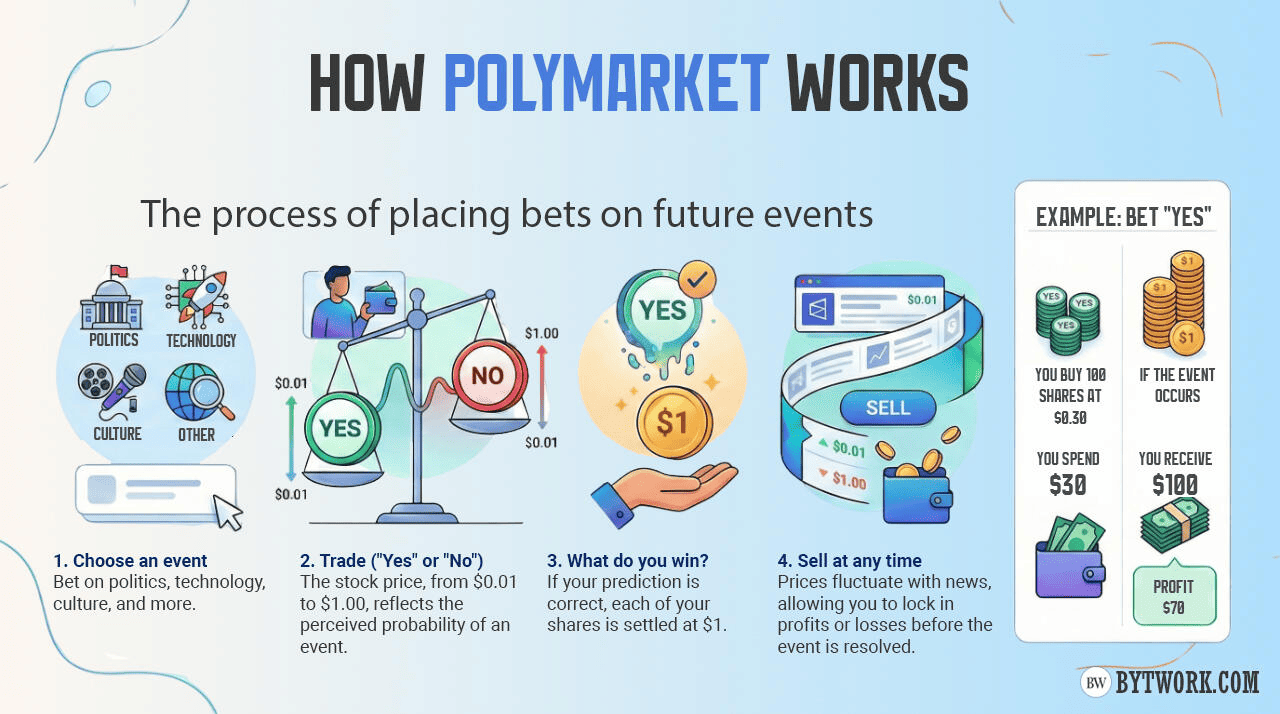
Source: Bytwork
Professionals profit by recognizing that price does not always equal true probability. Understanding how pros profit on Polymarket means focusing on structural inefficiencies, liquidity dynamics, and disciplined execution rather than directional forecasting or headline speculation.
What Are the Main Polymarket Trading Strategies and How Do They Work?
Polymarket Trading Strategies are structured frameworks designed to exploit probability mispricing in prediction markets. These strategies fall into five core categories: arbitrage, information edge, behavioral bias, time-based inefficiency, and structured capital discipline. Each approach differs in edge source, capital intensity, structural risk, and execution profile.
Arbitrage & Structural Inefficiency Strategies
1. Cross-Platform Arbitrage
Cross-Platform Arbitrage involves buying a contract at a lower implied probability on one platform and selling the equivalent contract at a higher implied probability elsewhere. This Polymarket Arbitrage Strategy focuses on locking pricing spreads rather than predicting outcomes.
- Exploit Polymarket vs Kalshi arbitrage gaps
- Require synchronized capital allocation
- Minimize directional exposure
2. Correlation Trading
Correlation trading identifies linked markets that should move together but temporarily diverge.
- Apply a Polymarket correlation trading strategy
- Target dependent outcomes priced inconsistently
- Capture probability convergence
3. Positive EV Grinding
Positive EV grinding targets underpriced high-probability contracts that drift toward fair value.
- Apply Prediction Market Arbitrage principles
- Focus on mathematical expected value
- Capture long-term probability convergence
4. Polymarket Market Making
Polymarket Market Making captures bid-ask spreads by providing liquidity.
- Exploit Polymarket liquidity and spreads
- Generate repeated micro-spread gains
- Requires disciplined Polymarket Risk Management
Information Edge Strategies
1. Information Arbitrage Polymarket
- Trade within 30–60 seconds of breaking news
- Capture early repricing inefficiencies
- Infrastructure speed determines profitability
2. Fake News Pattern Recognition
- Detect recycled hoaxes
- Fade emotional overreaction spikes
- Exploit misinformation volatility
3. Break Media Narratives
- Compare local data vs mainstream reporting
- Trade narrative divergence
- Enter before global repricing
4. Fed Signal Trading
- Monitor central bank tone shifts
- Front-run macro probability changes
- Trade macro-sensitive markets
5. Whale Tracking on Polymarket
- Monitor high-conviction wallets
- Allocate small percentage per trade
- Integrate structured Polymarket Bankroll Management
Behavioral Bias & Narrative Strategies
1. “Nothing Ever Happens” Fade
- Fade emotional geopolitical spikes
- Trade mean reversion
- Exploit panic mispricing
2. Mentions Market Default-to-NO Strategy
- Default to NO in short-duration mention markets
- Exploit structural YES bias
3. Girlfriend Poll Alpha
- Identify demographic mispricing
- Use off-platform sentiment sampling
4. Main-Character Rotation
- Position early in emerging narrative cycles
- Avoid consensus crowding
Time-Based Inefficiency Strategies
1. Riskless Rate Discounting
- Exploit time decay strategy Polymarket distortions
- Target long-dated contracts
- Capture uncertainty premium contraction
2. Cultural Calendar Alpha
- Recognize political timing psychology
- Fade overpricing near symbolic dates
3. Partial Resolution Advocacy
- Anticipate ambiguous contract interpretation
- Trade resolution mechanics rather than outcomes
Capital Discipline Strategy
1. Structured Polymarket Bankroll Management
- Apply 2–5% allocation per trade
- Optimize capital allocation for prediction markets
- Integrate core Polymarket Risk Management
Which Polymarket Trading Strategy Has Lower Risk?
The table below compares Polymarket Trading Strategies by core edge source, structural risk, capital requirement, and execution speed. This structured comparison helps traders align strategy selection with bankroll size, infrastructure capability, and Polymarket Risk Management discipline.
| Strategy | Category | Core Edge Source | Structural Risk | Typical Capital Required | Execution Speed |
| Cross-Platform Arbitrage | Arbitrage | Pricing gaps across platforms | Low | $1K–$10K+ | Fast |
| Correlation Trading | Arbitrage | Linked-event mispricing | Medium | Medium | Fast |
| Positive EV Grinding | Value | Underpriced high-probability outcomes | Medium | Low–Medium | Moderate |
| Polymarket Market Making | Liquidity | Bid-ask spread capture | Medium | $10K+ | Continuous |
| Information Arbitrage Polymarket | Information Edge | Breaking news speed | Medium | $2K+ | Very Fast |
| Fake News Pattern Recognition | Information Edge | Hoax detection | Medium | Low–Medium | Fast |
| Break Media Narratives | Information Edge | Narrative divergence | Medium | Low–Medium | Moderate |
| Fed Signal Trading | Macro | Policy probability shifts | Medium | Medium | Fast |
| Whale Tracking on Polymarket | Information Asymmetry | Smart-wallet monitoring | Medium | Medium | Reactive |
| Nothing Ever Happens Fade | Behavioral | Emotional reversion | Medium | Low | Moderate |
| Mentions Market Default-to-NO | Behavioral | Structural YES bias | Medium | Low | Fast |
| Girlfriend Poll Alpha | Behavioral | Demographic mispricing | Medium | Low | Moderate |
| Main-Character Rotation | Narrative | Attention-cycle positioning | Medium | Medium | Moderate |
| Riskless Rate Discounting | Time Decay Strategy Polymarket | Long-dated distortion | Medium | Medium | Slow |
| Cultural Calendar Alpha | Timing | Political date clustering | Medium | Low–Medium | Slow |
| Partial Resolution Advocacy | Structural | Contract ambiguity | Medium–High | Medium | Event-Based |
| Polymarket Bot Trading | Automation | Latency & execution efficiency | Medium–High | $10K+ | Automated |
How to Make Money on Polymarket Using Proven Trading Strategies
To make money on Polymarket, traders must identify probability mispricing, apply structured Polymarket Risk Management, allocate capital strategically, and execute efficiently. Profitability comes from exploiting arbitrage, liquidity inefficiencies, and behavioral bias — not from predicting headlines.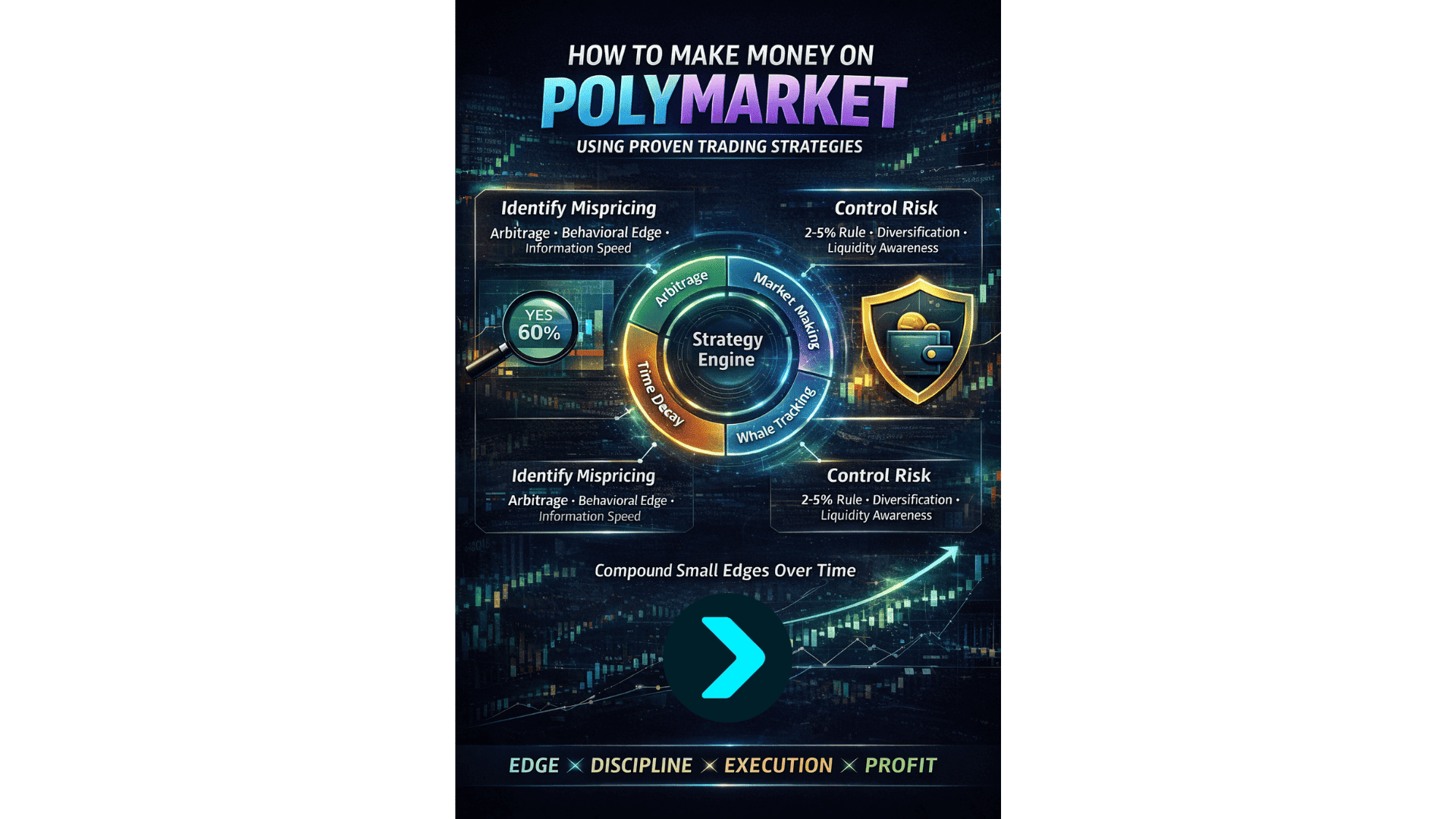
Step 1 — Identify Probability Mispricing
The foundation of making money on Polymarket is recognizing when market price diverges from true probability.
Focus on:
- Prediction market arbitrage across platforms
- Structural YES bias in short-duration contracts
- Correlation gaps between related outcomes
- Emotional overreaction in headline-driven markets
When price ≠ probability, edge exists.
Step 2 — Select the Right Polymarket Trading Strategy for Your Capital
Strategy selection must match capital size and risk tolerance.
- Low capital ($1K–$5K) → Cross-Platform Arbitrage and behavioral fades
- Medium capital ($5K–$25K) → Whale Tracking on Polymarket and correlation trading
- High capital ($25K+) → Polymarket Market Making and Polymarket Bot Trading
Proper capital allocation increases stability and reduces variance.
Step 3 — Apply Strict Polymarket Risk Management Before Scaling
Polymarket Risk Management determines survival.
Implement:
- 2–5% maximum allocation per trade
- No correlated stacking across linked markets
- Liquidity checks before position entry
- Structured Polymarket Bankroll Management rules
Long-term profitability depends more on drawdown control than win rate.
Step 4 — Improve Execution Speed and Infrastructure
Execution inefficiency destroys edge.
To optimize:
- Use fast infrastructure for information arbitrage Polymarket trades
- Monitor Polymarket liquidity and spreads during volatility
- Minimize slippage in low-volume markets
- Automate where possible through Polymarket Bot Trading
Speed compounds advantage in news-driven markets.
Step 5 — Compound Small Edges Consistently
Making money on Polymarket is not about single large wins.
It is about:
- Positive EV grinding
- Consistent position sizing
- Avoiding emotional over-sizing
- Monthly performance review and edge recalibration
Small advantages, repeated with discipline, generate exponential long-term results.
Strategic Formula for Long-Term Profitability
Profitability = Probability Edge × Risk Control × Capital Discipline × Execution Speed
Why Is Polymarket Risk Management Critical for Long-Term Profitability?
Polymarket Risk Management determines long-term survival. Even profitable Polymarket Trading Strategies fail without disciplined position sizing, structured Polymarket Bankroll Management, and strategic capital allocation for prediction markets. Edge generation is meaningless if capital volatility forces liquidation before probability convergence occurs.
Sustainable profitability depends less on win rate and more on drawdown control, liquidity preservation, and risk distribution across uncorrelated markets.
Position Sizing Rules
Position sizing is the foundation of Polymarket Risk Management. Improper sizing magnifies volatility and increases ruin probability.
Core principles include:
- Conservative Kelly criterion application (fractional Kelly, not full Kelly)
- Strict 2–5% maximum risk per trade
- Tail-event protection in geopolitical or macro-driven contracts
- Avoiding overexposure to binary, high-volatility outcomes
The objective is capital longevity, not short-term maximization.
Diversification Across Categories
Diversification reduces correlation risk across prediction markets.
Effective diversification includes:
- Avoiding overconcentration in one political, macro, or cultural theme
- Balancing short-duration and long-dated contracts
- Monitoring event correlation risk between linked outcomes
- Preserving liquidity flexibility during volatility spikes
Diversification combined with disciplined Polymarket Bankroll Management transforms small edges into compounding returns.
How Does Polymarket Bot Trading and Algorithmic Automation Work?
Polymarket Bot Trading automates Cross-Platform Arbitrage, Polymarket Market Making, and information arbitrage Polymarket strategies while embedding systematic Polymarket Risk Management controls. Instead of relying on discretionary execution, algorithmic systems monitor probability discrepancies, order book depth, and liquidity conditions in real time.

Automation transforms manual edge detection into repeatable, latency-sensitive execution. However, profitability depends on risk controls as much as speed.
When Does Polymarket Bot Trading Outperform Manual Trading?
Polymarket Bot Trading outperforms manual execution in environments where timing precision determines profitability.
Automation excels in:
- High-frequency Cross-Platform Arbitrage
- Continuous Polymarket Market Making spread capture
- Rapid response to breaking news in information arbitrage Polymarket strategies
- Removing emotional bias from execution decisions
When price discrepancies exist for seconds rather than minutes, algorithmic execution preserves edge.
Liquidity, Slippage, and Risk Controls in Automated Systems
Automation increases execution speed but also amplifies risk if not properly controlled.
Effective Polymarket Bot Trading systems must:
- Monitor Polymarket liquidity and spreads in real time
- Adjust position size based on order book depth
- Control slippage in low-volume or volatile markets
- Enforce capital allocation limits across simultaneous trades
- Integrate structured Polymarket Risk Management safeguards
Without embedded capital controls, algorithmic systems can overextend exposure faster than manual traders.
What Is the Best Polymarket Strategy for Beginners?
The best Polymarket strategy for beginners is a low-risk Polymarket Arbitrage Strategy combined with disciplined Polymarket Risk Management and structured Polymarket Bankroll Management. Beginners should prioritize probability-based frameworks that reduce directional exposure rather than attempting to forecast complex political or macro outcomes.
Simplicity, liquidity focus, and capital protection are the primary objectives during the early learning phase.
Why Is a Polymarket Arbitrage Strategy the Safest Entry Point?
A Polymarket Arbitrage Strategy minimizes the need for directional forecasting and instead focuses on pricing gaps between equivalent or correlated contracts.
Key advantages include:
- Reduced reliance on narrative prediction
- Lower volatility compared to outright directional bets
- Clear mathematical edge through implied probability discrepancies
- Defined entry and exit logic
For beginners, structured arbitrage reduces emotional bias and reinforces disciplined execution habits.
How Beginners Make Money on Polymarket Safely
New traders should prioritize risk control before profit maximization.
Best practices include:
- Limit exposure to 2–3% per trade
- Focus on high-liquidity markets with tighter Polymarket liquidity and spreads
- Avoid correlated positions that amplify drawdowns
- Apply strict Polymarket Risk Management rules consistently
- Track performance and adjust capital allocation gradually
Beginners make money on Polymarket not by taking bigger risks, but by protecting capital while compounding small, repeatable edges.
How Can Bitget Wallet Improve Polymarket Trading Strategies?
Executing Polymarket Trading Strategies requires efficient stablecoin management, fast capital deployment, and secure infrastructure. Execution speed, asset mobility, and cost efficiency directly impact arbitrage profitability, Polymarket Market Making returns, and overall Polymarket Risk Management performance.
Infrastructure does not create edge — but it determines whether edge can be captured consistently.
Stablecoin Earn Plus and Capital Efficiency
Idle stablecoin capital can remain productive while preserving rapid redeployment capability.
With Stablecoin Earn Plus:
- Idle USDC generates yield without locking capital long-term
- Capital allocation for prediction markets remains flexible
- Funds can be redeployed quickly into Cross-Platform Arbitrage opportunities
- Liquidity remains available for Polymarket Market Making strategies
Efficient capital utilization improves risk-adjusted returns without sacrificing execution readiness.
Zero-Fee Trading and Execution Speed
Reduced transaction friction improves arbitrage timing and probability capture.
Key advantages include:
- Zero-fee trading features lower execution costs
- Faster confirmations improve information arbitrage Polymarket timing
- Reduced slippage risk during volatility
- Greater precision for Polymarket Bot Trading automation
Lower friction compounds over high-frequency strategies.
Asset Mobility and Secure Infrastructure
Non-custodial, multi-chain infrastructure strengthens structured Polymarket Risk Management.
Core infrastructure benefits include:
- Seamless asset transfers for rapid capital movement
- Multi-chain compatibility for broader liquidity access
- Self-custody security model
- Greater control over capital allocation and exposure
Secure infrastructure ensures Polymarket Trading Strategies can scale without operational risk undermining profitability.
Related Reading on Prediction Market in Crypto
Crypto prediction markets allow users to trade event outcomes as probability-based contracts on blockchain networks. From understanding how decentralized prediction markets work to learning how Yes-No contracts are structured and traded, this complete guide series walks you through the fundamentals, risks, trading mechanics, and leading platforms in the ecosystem.
🔹 Understanding Prediction Market Fundamentals
- What Is a Prediction Market in Crypto and How Blockchain-Based Prediction Markets Work
- Types of Prediction Market: Real Money, Play Money, and Decentralized Systems
🔹 Risks and Investor Considerations
🔹 Yes-No Contracts and Binary Trading Mechanics
- What Is a Yes No Market: How Investors Trade Probabilities Using Yes-or-No Contracts
- How to Trade on Yes-No Market: A Practical Guide to Binary Prediction Trading
🔹 Platform Insights and Market Leaders
- Top Polymarket Projects Ranked by Liquidity, Active Users, and Market Impact
- Polymarket Trading Strategies: How to Make Money on Polymarket?
Conclusion
Polymarket Trading Strategies succeed when traders combine arbitrage logic, behavioral awareness, disciplined Polymarket Risk Management, and structured capital allocation for prediction markets. Edge alone is not enough — consistency comes from probability discipline, controlled position sizing, and execution efficiency across multiple strategy categories.
To make money on Polymarket sustainably, focus on repeatable frameworks rather than narratives or emotional forecasting. Apply structured Polymarket Bankroll Management, protect downside exposure, and use secure infrastructure like Bitget Wallet to deploy capital efficiently across markets while preserving speed, liquidity access, and operational control.
Download Bitget Wallet now to execute Polymarket Trading Strategies faster, reduce friction, and protect your capital.
Sign up Bitget Wallet now - grab your $2 bonus!
FAQs
1. What are Polymarket Trading Strategies?
Polymarket Trading Strategies are structured frameworks designed to exploit probability mispricing in prediction markets. Instead of predicting outcomes, traders focus on arbitrage opportunities, liquidity inefficiencies, behavioral bias, and disciplined Polymarket Risk Management to generate consistent edge over time.
2. How do pros profit on Polymarket consistently?
Professionals profit by targeting structural inefficiencies such as Cross-Platform Arbitrage, correlation gaps, and information arbitrage Polymarket setups. They combine strict Polymarket Bankroll Management, controlled position sizing, and fast execution infrastructure. Many use secure tools like Bitget Wallet to move capital quickly and reduce execution friction when timing matters.
3. What is the safest Polymarket arbitrage strategy?
The safest approach is Cross-Platform Arbitrage, where traders buy and sell equivalent contracts across platforms to lock pricing spreads. This Polymarket Arbitrage Strategy minimizes directional forecasting and focuses on mathematical discrepancies between implied probabilities.
4. Does Whale Tracking on Polymarket actually work?
Whale Tracking on Polymarket can be effective when used selectively. Monitoring high-conviction wallets may reveal informational edge, but it should always be combined with independent validation and structured Polymarket Risk Management to avoid blindly copying trades.
5. Is Polymarket Bot Trading profitable for beginners?
Polymarket Bot Trading can be profitable, but it requires sufficient capital, automation expertise, and embedded risk controls. Beginners should first master manual arbitrage and bankroll discipline before scaling into automation. Using reliable infrastructure like Bitget Wallet helps maintain capital mobility and execution speed when transitioning to more advanced strategies.
Risk Disclosure
Please be aware that cryptocurrency trading involves high market risk. Bitget Wallet is not responsible for any trading losses incurred. Always perform your own research and trade responsibly.