Clarity Act Stablecoin Yield Ban: Why Circle Stock Is Crashing in 2026 and What It Means for USDC
Clarity Act stablecoin yield ban is at the center of one of the biggest crypto-equity shocks in 2026, as updated legislative language triggered an immediate market reaction. Within hours, Circle’s stock plunged between 18–22%, marking its sharpest single-day decline since listing, reflecting a core concern that removing yield could structurally weaken issuer revenue models and intensify questions around why Circle stock is dropping so sharply in 2026. This reaction signals a broader repricing of risk, as investors reassess how stablecoins generate demand in a market where passive incentives are increasingly restricted.
This shift extends well beyond one company, as the emerging stablecoin rewards ban 2026 creates uncertainty around USDC yield regulation and reshapes capital flows across retail and institutional markets. Under the evolving US stablecoin law Clarity Act, policymakers are redefining how stablecoins function, forcing a transition toward utility-driven models, while tools like Bitget Wallet help users adapt by providing flexible, multi-chain access to alternative opportunities in a rapidly changing environment.
Key Takeaways
- The Clarity Act stablecoin yield ban is driving structural changes in issuer revenue models, contributing directly to the Circle stock crash 2026 as markets reprice regulatory risk
- USDC yield regulation and the stablecoin rewards ban 2026 are likely to eliminate balance-based rewards, weakening user incentives and demand for stablecoins
- Investors must reassess stablecoin strategies as the stablecoin rewards ban 2026 reshapes liquidity flows and long-term market dynamics
Clarity Act Stablecoin Yield Ban: What’s Driving the Circle Stock Crash in 2026?
The Clarity Act stablecoin yield ban restricts issuers from offering rewards on user balances, fundamentally altering how stablecoins generate demand and user retention. This regulatory shift is a primary reason why Circle stock is dropping, as investors reassess the sustainability of USDC-driven revenue models.
As reflected in recent market pricing, the reaction has been immediate and structural rather than temporary. Understanding this framework is essential to explaining why Circle stock is crashing in 2026 and how regulatory risk is being repriced across crypto-linked equities.
What Does the Clarity Act Actually Say About Stablecoin Yield?
The Clarity Act stablecoin yield ban prohibits issuers from offering interest or reward-based incentives tied to stablecoin balances, including indirect mechanisms that replicate yield. This stricter interpretation of the stablecoin yield ban US under the US stablecoin law Clarity Act significantly limits how issuers compete for user capital.
- Prohibits yield or reward payments on stablecoin balances
- Targets “economically equivalent” incentives
- Limits competitive differentiation between issuers
This reflects a stricter interpretation of stablecoin yield ban US under the US stablecoin law Clarity Act.
Why Is Circle Stock Crashing in 2026 After the Policy Update?
The Circle stock crash 2026 reflects a rapid repricing of risk as investors recognize the loss of yield-driven growth and declining demand incentives. Markets are reassessing long-term revenue expectations, pushing the Circle CRCL stock price today significantly lower.
- Loss of yield-driven growth model
- Reduced user acquisition incentives
- Higher regulatory risk premium
Markets quickly priced in downside risk, pushing Circle CRCL stock price today significantly lower.
How the Yield Ban Impacts Circle’s Revenue Model and Growth Outlook
Circle’s revenue model is closely tied to USDC circulation, where higher supply leads to larger reserves and increased interest income. Under new USDC yield regulation, removing yield incentives weakens demand growth, directly contributing to the Circle stock crash 2026.
- More USDC → larger reserves → higher income
- Yield incentives historically drove:
- adoption
- retention
- supply growth
Platforms like Coinbase amplify USDC distribution, but under new USDC yield regulation, removing incentives weakens demand—contributing directly to the Circle stock crash 2026.
Source: TOPONE Markets
What Does the Senate Clarity Act Mean for Stablecoin Yield and Rewards?
The Senate version of the Clarity Act stablecoin yield ban targets rewards earned from simply holding stablecoins, removing a key driver of adoption. This shift is a major factor behind the Circle stock crash 2026, as investors reassess yield-based growth models.
It also signals a broader transition toward utility-driven stablecoin use, reducing reliance on passive income incentives. As a result, markets are repricing risk quickly, reflecting structural changes in how stablecoins generate value.
What Balance-Based Rewards and Yield Models Are Restricted Under the Senate Clarity Act?
The Senate version of the Clarity Act stablecoin yield ban targets rewards earned simply by holding stablecoins, eliminating a core adoption mechanism. This forms the foundation of the stablecoin rewards ban 2026, directly impacting how issuers attract and retain user capital.
- No interest, rewards, or yield on passive balances
- Applies to both direct and indirect incentives
- Targets adoption strategies built on passive rewards
This forms the core of the stablecoin rewards ban 2026.
How Does the Senate Clarity Act Separate Passive Yield From Activity-Based Rewards?
The legislation draws a clear line between passive income and activity-driven incentives, restricting yield earned without user engagement. However, ambiguity around implementation is creating uncertainty, contributing to why Circle stock is dropping.
- Passive rewards are restricted
- Activity-based incentives may remain
- Boundaries remain unclear
This distinction introduces uncertainty across platforms and contributes to why Circle stock is dropping.
Why Are Rewards on Stablecoin Balances Being Targeted by Regulators?
Regulators are targeting passive rewards because they resemble traditional interest-bearing financial products without equivalent oversight. This approach aligns with broader crypto regulation 2026 efforts to reduce systemic risk and clarify the role of stablecoins.
- Passive yield resembles bank deposits
- Raises concerns about unregulated financial products
- Goal: separate payments from investment functions
This aligns with broader crypto regulation 2026 trends.
How Does This Policy Affect Stablecoin Usage and Global Capital Flows?
The removal of yield incentives reduces long-term holding demand for stablecoins, making capital more mobile across platforms and jurisdictions. Under evolving USDC yield regulation, this shift is expected to accelerate global liquidity movement and reshape market behavior.
- Lower incentives to hold USDC
- Capital may shift to:
- DeFi
- offshore markets
- Increased liquidity movement globally
This is a key shift under USDC yield regulation.
How This Shift Is Contributing to the Circle Stock Crash in 2026
The loss of yield-based incentives weakens USDC demand, directly affecting Circle’s ability to grow reserves and generate revenue. This dynamic is a key factor behind the Circle stock crash 2026, reinforcing the broader Coinbase Circle impact.
- Weakens USDC demand
- Reduces reserve growth
- Triggers valuation repricing
This reinforces the Coinbase Circle impact, as distribution channels lose efficiency.
What Happened in the Timeline of Events That Triggered the Circle Stock Crash?
The Circle stock crash 2026 followed a rapid sequence of regulatory developments tied to the Clarity Act stablecoin yield ban. Markets reacted almost instantly as new policy details removed uncertainty around stablecoin yield restrictions.
March 23, 2026 — Clarity Act Yield Ban Language Clarified
Updated draft language confirmed that reward mechanisms tied to stablecoin balances would be restricted, including indirect incentives. This clarity reinforced expectations around the Clarity Act stablecoin yield ban, signaling a stricter regulatory direction.
- Draft confirms no rewards on balances
- Expands restrictions to indirect incentives
- Signals strict regulatory stance
March 24, 2026 — Circle Stock Crashes on Market Reaction
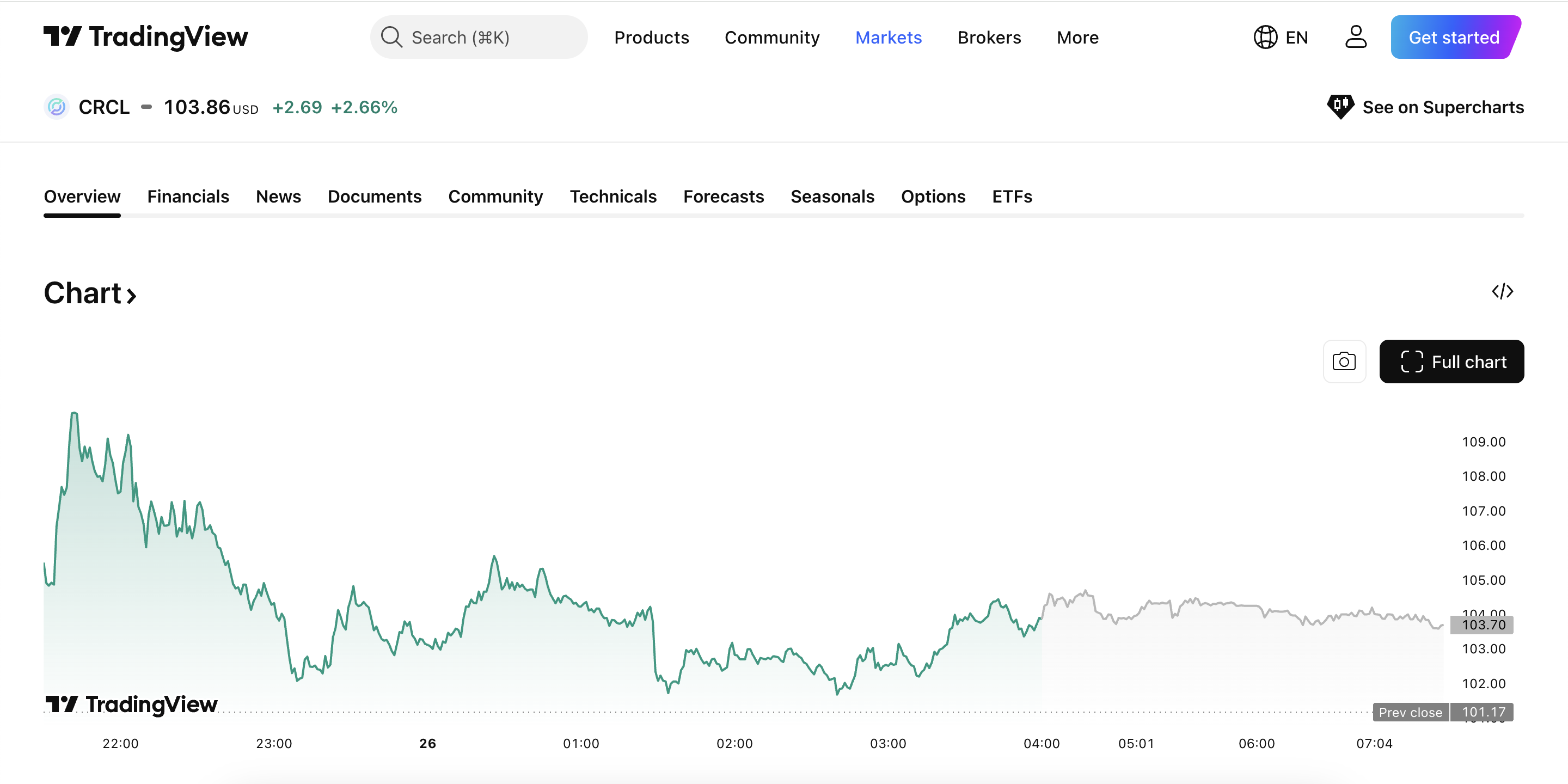
The confirmation of yield restrictions triggered immediate repricing, leading to the Circle stock crash 2026 as investors reassessed future earnings. The sharp decline reflects heightened concern over revenue sustainability and structural changes in the stablecoin model.
- Stock drops 18–22%
- Investors react to:
- revenue risk
- structural change
Search interest surged for why Circle stock is dropping.
Source: TradingView
Same-Day Reactions — Industry and Market Response
Analysts and investors immediately interpreted the selloff as a structural repricing rather than a temporary shock, driven by concerns that the Clarity Act stablecoin yield ban could weaken long-term demand for USDC. Market commentary also highlighted uncertainty around future policy outcomes, amplifying volatility and reinforcing the broader narrative around the stablecoin rewards ban 2026.
Analysts warned that banning yield could reduce demand for stablecoins and directly impact Circle’s growth outlook, according to The Motley Fool.
Some market strategists argued the selloff may be overdone, suggesting the policy could reshape competitive dynamics rather than eliminate opportunity, as reported by CoinDesk.
Broader crypto equities also showed heightened volatility as investors reassessed the implications of the stablecoin rewards ban 2026 across the sector, as noted by Yahoo Finance.
How Does the Clarity Act Stablecoin Yield Ban Impact USDC and Stablecoin Rewards in 2026?
The stablecoin rewards ban 2026 significantly reduces the attractiveness of holding USDC, especially for users seeking passive income. As USDC yield regulation tightens, the role of stablecoins is shifting from yield-generating assets toward purely transactional and liquidity functions.
How USDC Yield Regulation Changes User Behavior
The removal of passive rewards alters user incentives, making long-term stablecoin holding less appealing. Under new USDC yield regulation, capital is expected to become more mobile as users actively seek alternative yield opportunities.
- Lower holding incentives
- Shift to alternative yield sources
- Reduced liquidity stickiness
Will USDC Still Offer Yield After the Clarity Act?
The Clarity Act stablecoin yield ban is likely to eliminate direct yield on stablecoin balances, removing a core driver of adoption. While indirect or activity-based incentives may still emerge, the future of yield remains uncertain under evolving regulation.
- Direct yield likely eliminated
- Indirect incentives uncertain
- Platforms may adapt models
This answers a key investor question: will USDC still offer yield after Clarity Act?
What Does Circle CRCL Stock Price Today Reveal About Market Expectations?
The Circle CRCL stock price today reflects a rapid repricing of regulatory risk following the Clarity Act stablecoin yield ban. Investors are adjusting expectations as the Circle stock crash 2026 signals structural changes in revenue models tied to USDC.
| Metric | Value |
| Drop | 18–22% |
| Low price | ~$101 |
| Trigger | Yield ban |
| Secondary factor | Tether audit |
Key Drivers Behind the Circle Stock Crash
The Circle stock crash 2026 is driven by a combination of revenue pressure and declining user incentives under new regulation. As yield-driven growth weakens, markets are factoring in slower expansion and higher long-term risk.
- Revenue compression
- Reduced adoption incentives
- Regulatory uncertainty
Is This a Short-Term Shock or Why Circle Stock Is Dropping in 2026?
The decline is increasingly viewed as a structural shift rather than a temporary correction, driven by evolving policy under the Clarity Act stablecoin yield ban. This helps explain why Circle stock is dropping, as institutional sentiment adjusts to a more constrained growth outlook.
- Structural regulatory change
- Long-term impact on business models
- Institutional sentiment shift

What Should USDC Holders and Crypto Investors Do After the Yield Ban?
As the Clarity Act stablecoin yield ban reshapes the market, investors must shift from passive yield strategies to more active portfolio management. The stablecoin rewards ban 2026 is forcing a reassessment of risk, return, and liquidity across stablecoin allocations.
1. Reassess Stablecoin Allocation Strategy
The removal of yield incentives changes the risk-return profile of stablecoins, making diversification more important. Investors should evaluate how USDC yield regulation impacts portfolio balance and long-term capital allocation.
- Diversify holdings
- Balance risk vs yield
2. Explore Alternative Yield Opportunities
With traditional stablecoin yield restricted, capital is likely to move toward alternative sources of return. These include decentralized finance, offshore markets, and tokenized real-world assets that operate outside the scope of the stablecoin rewards ban 2026.
- DeFi lending
- offshore platforms
- real-world asset tokenization
3. Focus on Self-Custody and Flexibility
In a shifting regulatory landscape, control over assets becomes a strategic advantage. Self-custody solutions allow users to adapt quickly as USDC yield regulation evolves across jurisdictions.
- Greater asset control
- faster reaction to policy changes
How Can Bitget Wallet Help Navigate Stablecoin Yield Changes?
As USDC yield disappears under the Clarity Act stablecoin yield ban, users need alternative ways to access yield across global markets. In a landscape shaped by the stablecoin rewards ban 2026, flexibility, security, and access to diverse opportunities become critical.
Managing stablecoins in a yield-restricted environment
Bitget Wallet enables users to adapt by providing broad access to decentralized opportunities beyond traditional stablecoin yield. With support for over 130+ main chains, more than 20,000 DApps, and access to 1 million tokens, it allows users to explore yield strategies across multiple ecosystems.
- multi-chain access
- DeFi integration
- self-custody control
Why this matters after the stablecoin yield ban
As centralized yield options decline, users need tools that provide both security and flexibility in managing digital assets. With a global base of over 90 million users and a $300 million Protector Fund, Bitget Wallet offers infrastructure designed to support capital mobility in a rapidly evolving regulatory environment.
- fewer centralized yield options
- need for flexible strategies
- global access to opportunities
Related Reading on USDT & USDC Yield
If you're exploring USDT earn or USDC earn opportunities — from fixed APY savings to on-chain yield strategies — these guides will help you understand how stablecoin yield works, how to evaluate risk, and how to optimize returns safely.
🔹 Understanding Stablecoin Yield Basics
- Yield Farming: What Is It and How Does It Work?
- How to Earn Passive Income With Cryptocurrency? A Beginner’s Guide
🔹 USDT Earn & Yield
- USDT Earn Explained: How to Generate Yield on Tether Safely
- How to Earn Yield on USDT: Fixed vs Flexible APY Compared
🔹 USDC Earn & Yield
- USDC Earn Explained: A Complete Guide to Yield, APY, and Risk
- USDC Earn Returns: How to Evaluate APY, Liquidity, and Smart Contract Exposure
- Stablecoin Earn Plus: What USDC Earn Is and How to Start Generating Yield
🔹 Evaluating APY & Risk
- What Is APY in Crypto and How Yield Is Calculated
- Stablecoin Yield Risks: Smart Contracts, Counterparty & Liquidity
Conclusion
The Clarity Act stablecoin yield ban marks a structural turning point for crypto markets, removing balance-based incentives that once fueled stablecoin growth. This shift has already contributed to the Circle stock crash 2026, as investors reprice business models tied to yield and reassess long-term demand for assets like USDC.
At the same time, the stablecoin rewards ban 2026 is redefining how value is generated in the ecosystem, accelerating a move toward utility-driven adoption over passive income. In this evolving environment, tools like Bitget Wallet help users stay flexible, manage assets securely, and access global opportunities as yield dynamics continue to change.
Download Bitget Wallet to stay flexible, manage assets securely, and adapt to changing yield opportunities in an evolving regulatory landscape.
Sign up Bitget Wallet now - grab your $2 bonus!
FAQs
1. What is the Clarity Act stablecoin yield ban?
The Clarity Act stablecoin yield ban is a proposed U.S. regulation that restricts stablecoin issuers from offering interest or rewards on user-held balances. It aims to separate payment-focused stablecoins from investment-like products that resemble traditional financial instruments.
2. Why is Circle stock crashing in 2026?
The Circle stock crash 2026 is driven by concerns that removing yield incentives will weaken demand for USDC and reduce reserve-based revenue. Investors are also pricing in higher regulatory risk and a slower long-term growth trajectory.
3. Will USDC still offer yield after Clarity Act?
Under the USDC yield regulation framework, direct yield on stablecoin balances is likely to be restricted or eliminated. However, some platforms may explore indirect or activity-based incentives, though their structure remains uncertain.
4. What happens to stablecoin rewards under the Clarity Act?
The stablecoin rewards ban 2026 removes balance-based rewards that users earn simply by holding stablecoins. Activity-based incentives may still be allowed, but they will likely face stricter regulatory scrutiny.
5. Is stablecoin yield illegal in the US 2026?
Stablecoin yield is not entirely illegal, but it is heavily restricted under the stablecoin yield ban US introduced by the Clarity Act. The regulation primarily targets passive income models rather than all forms of incentives.
6. What should USDC holders do now?
USDC holders should reassess their portfolio strategy as the Clarity Act stablecoin yield ban changes the risk-return profile of stablecoins. Diversifying assets, exploring alternative yield opportunities, and using flexible tools like Bitget Wallet can help adapt to the new environment.
Risk Disclosure
Please be aware that cryptocurrency trading involves high market risk. Bitget Wallet is not responsible for any trading losses incurred. Always perform your own research and trade responsibly.