


What Is Telegram and Is It Safe for Private Messaging?
What is Telegram and is it safe for private messaging? Telegram is a cloud-based messaging platform designed to send messages, share media, and connect large communities through groups, channels, and automated tools. Unlike traditional messaging services, the Telegram messaging app stores messages in the cloud, allowing users to access conversations across multiple devices seamlessly.
Today, Telegram is widely used by individuals, businesses, and tech communities. Telegram has grown into one of the world’s largest messaging platforms, with hundreds of millions of active users globally. In particular, the Telegram crypto community relies heavily on the platform for project announcements, trading discussions, and developer collaboration. However, many users still wonder: is Telegram safe to use for private communication?
This guide explains what Telegram is, how the Telegram messaging app works, its security and privacy features, and the potential risks users should understand. We will also explore why the crypto industry uses Telegram and how tools like Bitget Wallet Telegram Lite bring Web3 functionality directly into Telegram chats.
Key Takeaways
- Telegram is a global messaging platform that supports private chats, large communities, channels, and automation through bots, making it widely used by online and crypto communities.
- Security and privacy depend on user settings, such as enabling two-step verification, using Secret Chats for end-to-end encryption, and avoiding suspicious links or scam bots.
- Telegram is deeply integrated with the Web3 ecosystem, where tools like Bitget Wallet Telegram Lite allow users to access blockchain services and crypto communities directly inside Telegram.
What Is Telegram?
Telegram is a cloud-based messaging platform that allows users to send text messages, share files, create large group chats, and broadcast information through channels. The Telegram messaging app is available across mobile devices, desktops, and web browsers, making it easy to stay connected across multiple platforms.
Because of its scalability and automation features, Telegram is often used by communities, businesses, and online organizations that need to communicate with large audiences quickly.
Key Features of the Telegram Messaging App
The Telegram messaging app offers several features that distinguish it from traditional messaging services:
- Cloud-based messaging: messages are stored in the cloud and synced across devices.
- Cross-device synchronization: users can access chats from phones, tablets, or desktops.
- Large group chats: Telegram groups can host up to hundreds of thousands of members.
- File sharing: users can send photos, videos, documents, and large files.
- Voice and video calls: secure calls are supported directly within the app.
- Channels for broadcasting: administrators can broadcast updates to unlimited subscribers.
These features have made Telegram a widely used communication platform for both casual conversations and professional communities.
Differences Between Telegram Channels and Groups
One of the most distinctive features of the Telegram messaging app is its support for both groups and channels. While they may appear similar at first glance, Telegram channels and groups serve different purposes and are designed for different types of communication.
| Feature | Groups | Channels |
| Purpose | Discussion | Broadcasting |
| Member limit | Up to 200,000 | Unlimited |
| Interaction | Everyone can send messages | Admin posts content |
Telegram groups are designed for interactive discussions, where all members can participate in conversations. Channels, on the other hand, are typically used for announcements and updates where administrators broadcast messages to subscribers.
Because of this structure, Telegram channels and groups are widely used by online communities, businesses, and crypto projects to manage conversations and distribute information efficiently.
How Does Telegram Work?
Telegram operates through a cloud-based infrastructure. Messages, files, and media are stored on Telegram servers, which allows users to access their chats from multiple devices simultaneously.
Unlike traditional messaging systems that rely only on device storage, Telegram’s cloud system ensures conversations remain accessible even when users switch devices or reinstall the app.
1. Telegram Cloud Messaging System
Telegram operates using a cloud-based infrastructure that stores messages and media on secure servers rather than only on users’ devices. This cloud messaging system allows the Telegram messaging app to synchronize conversations across multiple devices while maintaining fast message delivery worldwide.
Telegram’s cloud system enables several advantages:
- Cloud storage of conversations
- Multi-device synchronization
- Fast global message delivery
- Access to chat history from any device
These capabilities make the Telegram messaging app especially useful for communities, businesses, and organizations that need reliable communication across phones, tablets, and desktop devices.

2. Telegram Bots and Automation
Another major feature of Telegram is its extensive bot ecosystem, which allows developers to create automated tools that operate directly inside chats. These Telegram bots can perform tasks, provide information, or automate services through simple commands or interactive buttons.
Common uses for Telegram bots include:
- Automated notifications
- Community management tools
- Trading alerts and market data
- Mini applications embedded in chats
Because Telegram bots allow developers to build automated services within conversations, they are widely used in online communities, digital platforms, and crypto ecosystems.

Is Telegram Safe for Private Messaging?
Many users ask: is Telegram safe for private messaging? The platform includes several security and privacy features designed to protect user conversations, but understanding how these tools work is important for safe usage.
The Telegram messaging app offers encryption options, authentication systems, and customizable privacy settings that help improve Telegram security. However, it is important to note that standard chats use a server-client encryption model, meaning end-to-end encryption is not enabled by default unless users activate Secret Chats.
1. Telegram Encryption and Secret Chats
One of the most important Telegram security features is the option for Telegram encryption and secret chats, which provide stronger protection for sensitive conversations.
Telegram offers multiple layers of encryption:
- Server-client encryption for standard chats
- End-to-end encryption through Secret Chats
- Self-destruct messages for sensitive conversations
Secret Chats ensure that messages remain visible only to the sender and the intended recipient, helping protect private conversations from unauthorized access.
2. Telegram Privacy Settings
In addition to encryption, Telegram includes several built-in Telegram privacy controls that allow users to customize how their information is shared within the app.
Users can adjust settings such as:
- Phone number visibility
- Last seen and online status
- Passcode lock protection
- Two-factor authentication
These privacy settings help strengthen Telegram security by limiting who can view personal information and reducing exposure to spam accounts or unknown contacts.
Is Telegram End-to-End Encrypted by Default?
Telegram does not enable end-to-end encryption by default in standard chats. Instead, it uses server-client encryption while Secret Chats provide full end-to-end encryption for private conversations.
This design allows Telegram to support cloud synchronization across devices, but users must enable Secret Chats if they require stronger message privacy.
Does Telegram Store User Data?
Like most messaging platforms, Telegram may store limited metadata such as login activity, device information, and IP addresses to maintain service reliability and security.
However, Telegram states that message content in Secret Chats remains accessible only to the participating users because it is protected by end-to-end encryption.
How Can You Use Telegram Safely?
Understanding how to use Telegram safely is essential for protecting your privacy and avoiding scams. Although the Telegram messaging app offers various privacy and security tools, users should still configure these settings and remain cautious when interacting with unknown contacts or links.
By adjusting privacy controls and following basic safety practices, users can significantly improve Telegram security and reduce exposure to spam, phishing attempts, and fraudulent communities.
What Are the Best Safety Tips for Telegram Users?
To improve Telegram security, users should take advantage of the platform’s built-in privacy settings and remain careful when interacting with unfamiliar accounts or bots.
Some simple ways to improve how to use Telegram safely include:
- Enabling two-factor authentication (2FA) for stronger account protection
- Hiding your phone number in privacy settings to limit who can see it
- Avoiding unknown bots or suspicious links sent through messages or groups
- Verifying crypto groups and trading communities before joining
- Using Secret Chats for sensitive conversations that require stronger privacy
Following these practices can help users reduce Telegram security risks and scams while protecting their personal information and online accounts.
What Are the Main Telegram Security Risks and Scams?
Although Telegram includes strong privacy features, users should still understand Telegram security risks and scams that may occur on the platform. Because Telegram supports large communities, bots, and public channels, scammers sometimes use the platform to target users through fraudulent messages or fake investment schemes.
While the Telegram messaging app itself provides security tools, users should remain cautious when interacting with unknown contacts, links, or groups.
1. Phishing Bots on Telegram
One of the most common Telegram security risks and scams involves phishing bots. These automated Telegram bots impersonate legitimate services such as crypto exchanges, wallets, or customer support teams.
Their goal is to trick users into revealing sensitive information such as passwords, verification codes, or crypto wallet private keys.
2. Fake Crypto Investment Groups
Another common scam involves fake crypto trading or investment groups. Scammers create Telegram communities that promise guaranteed profits, insider trading tips, or exclusive market signals.
These fake groups often imitate legitimate projects or well-known influencers to gain credibility. This type of fraud is particularly common within large Telegram crypto communities.
3. Malicious Links and Malware
Malicious links are another major security concern. Scammers may send links that redirect users to phishing websites designed to steal login credentials.
In some cases, these links may also download malware disguised as files or applications. Understanding these Telegram security risks and scams can help users avoid clicking suspicious links.
4. Spam Accounts and Impersonation
Spam accounts frequently send unsolicited messages promoting giveaways, investment opportunities, or suspicious offers.
Some scammers also impersonate administrators, project founders, or customer support agents. By pretending to represent legitimate services, they attempt to gain trust before requesting money or personal information.
Telegram vs WhatsApp vs Signal: Which Messaging App Is More Secure?
Telegram, WhatsApp, and Signal are among the most widely used messaging platforms in the world. However, they differ significantly in encryption models, privacy controls, and community features. While WhatsApp and Signal prioritize default end-to-end encryption for private conversations, Telegram focuses more on scalability, cloud synchronization, and large community support.
| Feature | Telegram | Signal | |
| Default encryption | Server-client encryption | End-to-end encryption | End-to-end encryption |
| Secret chats | Optional | Not needed (default E2E) | Default |
| Group size | Up to 200,000 members | About 1,000 members | About 1,000 members |
| Cloud synchronization | Yes | Limited | Limited |
| Crypto community usage | Very common | Rare | Rare |
1. Telegram vs WhatsApp
Telegram and WhatsApp are both extremely popular messaging services with global user bases. However, they are built with different priorities in mind. WhatsApp focuses primarily on encrypted private messaging, while Telegram is designed to support large communities, channels, and automation tools.
Pros of Telegram
- Supports extremely large groups and public channels
- Offers cloud synchronization across multiple devices
- Provides bot automation and developer integrations
- Popular platform for online communities and crypto projects
Cons of Telegram
- End-to-end encryption is not enabled by default
- Some metadata may be stored to support cloud services
- Privacy protection relies more heavily on user settings
Pros of WhatsApp
- End-to-end encryption enabled by default for all messages
- Simple interface optimized for private conversations
- Widely adopted with billions of global users
Cons of WhatsApp
- Smaller group size limits compared with Telegram
- Limited support for bots or automation tools
- Less suitable for large public communities
Because of these differences, WhatsApp is often preferred for private encrypted messaging, while Telegram is commonly used for large communities and discussion channels.
2. Telegram vs Signal
Signal is widely considered one of the most privacy-focused messaging apps available. The platform is designed with strong encryption and minimal data collection, making it popular among privacy advocates and security experts. Telegram, in contrast, balances privacy tools with scalability and platform flexibility.
Pros of Telegram
- Supports large communities and public discussion channels
- Allows bot automation and third-party integrations
- Provides cloud-based message synchronization across devices
- Flexible platform for communities, developers, and Web3 projects
Cons of Telegram
- End-to-end encryption must be enabled manually through Secret Chats
- Stores some metadata to support cloud infrastructure
Pros of Signal
- End-to-end encryption enabled by default for all conversations
- Minimal data collection and strong privacy design
- Open-source protocol widely trusted by security researchers
Cons of Signal
- Smaller user base compared with Telegram and WhatsApp
- Limited support for large communities or public channels
- Fewer automation tools and integrations
As a result, Signal is often considered the most privacy-focused messaging option, while Telegram offers greater flexibility for communities, automation tools, and large-scale communication environments.
Telegram’s support for large groups, public channels, and automated bots is also one reason the platform is widely adopted by digital communities, open-source projects, and cryptocurrency ecosystems.
Why Crypto Communities Use Telegram?
Telegram has become one of the most widely used communication platforms in the cryptocurrency ecosystem. Many blockchain projects rely on Telegram crypto communities to share updates, coordinate development discussions, and interact directly with users.
Because Telegram supports large groups, channels, and automation tools, it provides an ideal environment for community-driven projects and real-time discussions.
1. Community Building and Project Communication
One of the main reasons why crypto projects use Telegram is its ability to support large online communities. Telegram groups allow projects to interact directly with thousands of users in a single space.
Developers, founders, and community members can communicate in real time through Telegram channels and groups, making it easier to build strong and active communities around blockchain projects.
2. Token Launch Announcements and Airdrop Campaigns
Telegram channels are often used by blockchain projects to announce important updates and product launches. These announcements typically include new token listings, ecosystem developments, and community events.
Projects also use Telegram to distribute airdrops and reward early participants. These campaigns often reach large Telegram crypto communities, helping projects attract early adopters and investors.
3. Crypto Trading Communities and Market Discussions
Telegram also hosts many communities focused on trading strategies and market analysis. Within Telegram for crypto trading communities, users share trading signals, token insights, and real-time market updates.
In many groups, automated Telegram bots provide price alerts, trading notifications, or blockchain transaction updates to help traders stay informed.
4. Telegram Compared With Other Messaging Platforms
Different messaging platforms offer varying features for community communication, but not all are designed to support large-scale online communities. In the cryptocurrency ecosystem, platforms are often evaluated based on group size limits, automation tools, and the ability to broadcast updates to large audiences.
| Telegram | Channels, large groups, bots | Very high |
| Small private groups | Low | |
| Discord | Servers and voice channels | Moderate |
Because of its scalability, automation features, and ability to host large Telegram crypto communities, Telegram remains one of the most important platforms for blockchain projects and crypto traders.
What Are Telegram Bots and How Do They Support Web3 Tools?
Telegram bots are automated programs that run inside the Telegram messaging app and perform tasks through commands, messages, or interactive buttons. These bots allow developers to build services directly within chats, turning the Telegram messaging app into a platform for automation, community management, and digital tools.
In the Web3 ecosystem, Telegram bots enable users to interact with blockchain services without leaving the messaging interface. This makes Telegram an important tool for crypto communities that rely on real-time information, trading alerts, and decentralized applications.
How Are Telegram Bots Used in the Crypto and Web3 Ecosystem?
Within Telegram crypto communities, bots help automate many tasks that would otherwise require separate apps or websites.
Common uses of Telegram bots include:
- Tracking token prices
- Sending trading alerts
- Monitoring blockchain transactions
- Managing online communities
- Accessing Web3 mini-applications
Some bots also integrate crypto wallets directly into Telegram. For example, Bitget Wallet Telegram Lite allows users to create and manage wallets inside Telegram conversations, making it easier to send tokens and interact with Web3 tools without leaving the chat interface.
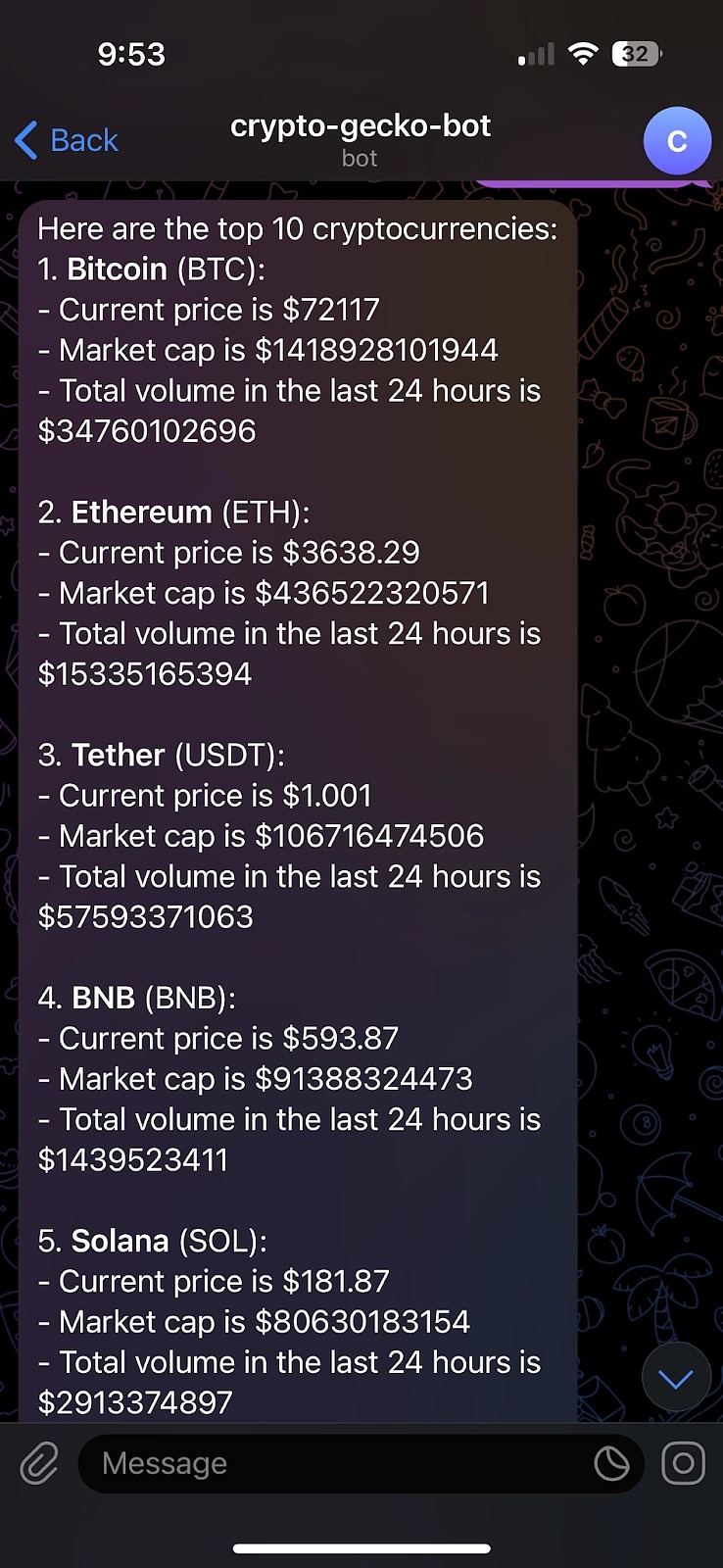
Source: CoinGecko
What Is Bitget Wallet Telegram Lite and How Does It Work Inside Telegram?
Bitget Wallet Telegram Lite is a Telegram bot that allows users to create and manage a crypto wallet directly inside the Telegram messaging app. Instead of switching between multiple apps, users can interact with blockchain services directly through Telegram conversations.
By integrating wallet functionality into Telegram, Bitget Wallet Telegram Lite crypto wallet bot enables users to create wallets, send tokens, and manage assets across multiple blockchains without leaving the chat interface.
What Can Users Do With Bitget Wallet Telegram Lite?
Bitget Wallet Telegram Lite crypto wallet bot provides several wallet features that can be accessed directly through Telegram.
With Bitget Wallet Telegram Lite crypto wallet bot, users can:
- Create a crypto wallet directly within Telegram
- Send and receive tokens inside chats
- Manage assets across multiple blockchains
- Access Web3 wallet functions through a Telegram bot interface
- Share wallet addresses easily within Telegram communities
These features allow users to interact with blockchain services more conveniently while remaining inside the Telegram messaging environment.
Why Are Telegram Wallets Becoming Popular in Web3?
Telegram-based wallets are gaining popularity because they simplify crypto onboarding and integrate financial tools directly into social platforms.
Benefits include:
- Social payments directly inside messaging apps
- Community finance within Telegram crypto communities
- Faster onboarding for users already active on Telegram
- Seamless integration between messaging platforms and Web3 tools
As Telegram continues to grow as a hub for blockchain discussions and trading communities, tools like Bitget Wallet Telegram Lite help bridge communication platforms with decentralized finance and Web3 applications.
How Can You Use Telegram Safely?
Understanding how to use Telegram safely is essential for protecting your privacy and avoiding scams. Although the Telegram messaging app offers various privacy and security tools, users should still configure these settings and remain cautious when interacting with unknown contacts or links.
By adjusting privacy controls and following basic safety practices, users can significantly improve Telegram security and reduce exposure to spam, phishing attempts, and fraudulent communities.
What Are the Best Safety Tips for Telegram Users?
To improve Telegram security, users should take advantage of the platform’s built-in privacy settings and remain careful when interacting with unfamiliar accounts or bots.
Some simple ways to improve how to use Telegram safely include:
- Enabling two-factor authentication (2FA) for stronger account protection
- Hiding your phone number in privacy settings to limit who can see it
- Avoiding unknown bots or suspicious links sent through messages or groups
- Verifying crypto groups and trading communities before joining
- Using Secret Chats for sensitive conversations that require stronger privacy
Following these practices can help users reduce Telegram security risks and scams while protecting their personal information and online accounts.
Related Reading on Telegram & Crypto Communities
Telegram has become one of the most widely used platforms in the crypto ecosystem — from trading communities and signal groups. These guides explain how Telegram works, how to use it safely, and how it connects to the broader Web3 and crypto trading landscape.
🔹 Understanding Telegram Basics
🔹 Telegram Security & Practical Tools
- How to Create a Virtual Number for Telegram and Avoid Account Ban Risks
- How to Download Telegram History: A Complete 2026 Guide for Backing Up Chats Safely
🔹 Telegram in the Crypto Ecosystem
- Best Crypto Signals Telegram Groups 2026: Top Channels for Profitable Trading Alerts
- Telegram Star to TON: What Are Telegram Stars and How to Withdraw and Convert (Guide)
Conclusion
What is Telegram and is it safe for private messaging? Telegram is a powerful messaging platform used worldwide for communities, communication, and automation tools.
It is especially popular in the crypto and Web3 ecosystem, where projects and traders use Telegram for updates, trading bots, and community discussions. However, users should always understand privacy settings and common scam risks to stay safe.
For Web3 users, tools like Bitget Wallet and Bitget Wallet Telegram Lite make it easier to access blockchain services directly inside Telegram.
Download Bitget Wallet to securely store assets, trade tokens, and explore Web3 directly from Telegram.
Sign up Bitget Wallet now - grab your $2 bonus!
FAQs
1. What is Telegram?
Telegram is a cloud-based messaging platform that allows users to send messages, share files, create groups, and broadcast updates through channels.
2. Is Telegram safe for private messaging?
Telegram can be safe when users enable privacy settings, use Secret Chats for sensitive conversations, and remain cautious about suspicious messages or links.
3. Why do crypto communities use Telegram?
Crypto communities use Telegram because it supports large groups, channels, and bots that allow projects to communicate with thousands of users.
4. What is Bitget Wallet Telegram Lite?
Bitget Wallet Telegram Lite is a Telegram bot that enables users to create and manage a crypto wallet directly within Telegram chats.
5. Is Telegram safer than WhatsApp?
Telegram offers strong privacy tools and optional end-to-end encryption through Secret Chats. However, WhatsApp enables end-to-end encryption by default for all conversations.
Risk Disclosure
Please be aware that cryptocurrency trading involves high market risk. Bitget Wallet is not responsible for any trading losses incurred. Always perform your own research and trade responsibly.

 Top Arc Tokens and Memecoins: What’s Trending on Arc Mainnet2026-09-16 | 5 mins
 Circle Arc Mainnet Launch: What Is Arc and Why Does It Matter?2026-09-14 | 5 mins
 Top Robinhood Chain Memecoins 20262026-09-09 | 5 mins



