SANAE TOKEN Controversy: Is Sanae Token a Scam or Legal? Issuance Halt and Compensation Explained

The SANAE TOKEN controversy has quickly become one of the most widely discussed crypto incidents in Japan in 2026. The situation involves politics, financial regulation, and the fast-moving world of blockchain assets.
At the center of the controversy is SANAE TOKEN, a Solana-based cryptocurrency that was created and distributed by a Web3 community project. The token was named after Japanese Prime Minister Sanae Takaichi, but according to public statements, the prime minister had no knowledge of the project and did not approve the use of her name.
As the story unfolded, several major questions began circulating across Japan’s crypto community. Many investors are asking whether SANAE TOKEN is a scam, whether the project was legally issued under Japanese financial regulations, and whether holders will receive compensation now that the token’s issuance has been halted.
This article explains the full SANAE TOKEN controversy, including the timeline of events, the regulatory response from Japan’s Financial Services Agency (FSA), and the compensation plan announced for affected holders. It also explores the broader risks associated with political-themed cryptocurrencies and how investors can navigate the market more safely using tools such as Bitget Wallet.
Key Takeaways
- SANAE TOKEN was issued in February 2026 by NoBorder DAO without confirmed consent from Prime Minister Sanae Takaichi
- Japan’s Financial Services Agency (FSA) launched an investigation after the issuer was found to lack a required crypto license
- The project halted token issuance and announced a restructuring and name change
- Compensation for holders is planned, based on a March 3 wallet snapshot
- Political meme coins carry higher risks in Japan due to strict financial regulation
What Is the SANAE TOKEN Controversy and Why Did It Go Viral?
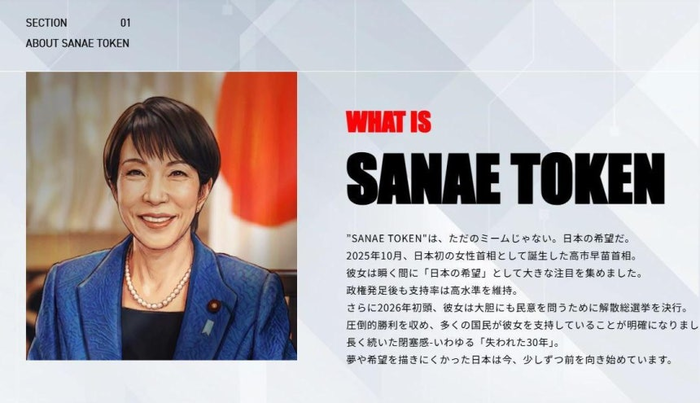
The SANAE TOKEN controversy began on February 25, 2026, when entrepreneur Yuji Mizoguchi’s Web3 community NoBorder launched a civic-tech initiative called “Japan Is Back.” As part of the initiative, the team issued SANAE TOKEN on the Solana blockchain as a reward mechanism for users who contributed political opinions and discussions within the platform.
Source X
Why the SANAE TOKEN Went Viral Among Japan Crypto Users
The project quickly attracted attention because it prominently featured the name and image of Prime Minister Sanae Takaichi. This presentation created the widespread impression that the project had some form of political endorsement.
However, on March 2, Prime Minister Takaichi publicly stated that she had no involvement with the token, which triggered immediate backlash and widespread speculation about whether the project had misled investors.
Key reasons the controversy went viral include:
- Takaichi’s official support organization “Team Sanae” initially promoted the project on X before deleting the post after her denial
- Marketing materials featured illustrations of the prime minister alongside the token branding
- A disclaimer existed on the website but was not prominent enough to counter the overall impression of endorsement
- Social media discussions rapidly escalated into fraud allegations and calls for regulatory action
Why the SANAE TOKEN Went Viral Among Japan Crypto Users ?
The SANAE TOKEN issuance halt was the result of a rapid sequence of events that unfolded within just five days.
After the token launched on February 25, Prime Minister Takaichi publicly denied involvement on March 2. On March 3, Japan’s Financial Services Agency announced that it would investigate the project’s operators. One day later, the issuing organization halted the project and announced a restructuring plan.
Key facts about why the SANAE TOKEN controversy went viral:
- PM Takaichi's official support organization "Team Sanae" initially promoted the project on X, then deleted the post after Takaichi's denial
- The token's website featured illustrations of PM Takaichi alongside SANAE TOKEN branding, despite a buried disclaimer stating no affiliation
- Takaichi's public denial on March 2 directly contradicted the impression created by the project's overall marketing
- Public backlash on X included widespread SANAE TOKEN fraud allegations and calls for regulatory intervention
- The contradiction between the disclaimer and the promotional activity became the defining issue of the controversy
Who Was Behind SANAE TOKEN and What Was the Original Intent?
SANAE TOKEN was issued by NoBorder, a Web3 DAO and YouTube community led by serial entrepreneur Yuji Mizoguchi. The project's civic-tech framing positioned it as a platform for aggregating citizen voices and channeling them toward political decision-makers — with SANAE TOKEN serving as a points-style reward for active participants. Understanding the original intent is important context for evaluating the fraud allegations.
Key details about the project's origin and structure:
- NoBorder presented the "Japan is Back" project as a digital democracy initiative, not a purely speculative financial product
- SANAE TOKEN was designed as an in-app community incentive on the Solana blockchain
- The official site included a disclaimer stating the token was not affiliated with or approved by Takaichi
- However, the simultaneous use of her name, likeness, and the promotional activity from her support group made the disclaimer functionally invisible to most users
- The gap between the disclaimer and the overall presentation is the core reason SANAE TOKEN fraud allegations gained such significant traction among the public and regulators
Why Was SANAE TOKEN Issuance Halted?
The SANAE TOKEN issuance halt was the direct result of a rapid five-day sequence of escalating events that left NoBorder with no viable path to continuing the project. The launch on February 25 was followed by PM Takaichi's public denial on March 2, the FSA's investigation announcement on March 3, and NoBorder's formal halt and restructuring statement on March 4.
The speed of this sequence reflects how quickly Japan’s crypto regulation can intervene when a project like SANAE TOKEN faces potential licensing violations, especially in a high-profile political case.
The three core reasons the SANAE TOKEN issuance halt was triggered:
-
Political legitimacy collapsed:
PM Takaichi's denial stripped SANAE TOKEN of its central value proposition — the implied association with a sitting prime minister.
-
Licensing violation identified:
NoBorder had issued and facilitated trading of a crypto asset without holding the required crypto exchange business license under Japan's Payment Services Act — creating potential legal exposure for the SANAE TOKEN project.
-
Regulatory escalation:
The FSA's announcement of an investigation made it legally untenable for NoBorder to continue operating, which ultimately forced the SANAE TOKEN issuance halt and triggered immediate damage control.
-
Issuer acknowledgement:
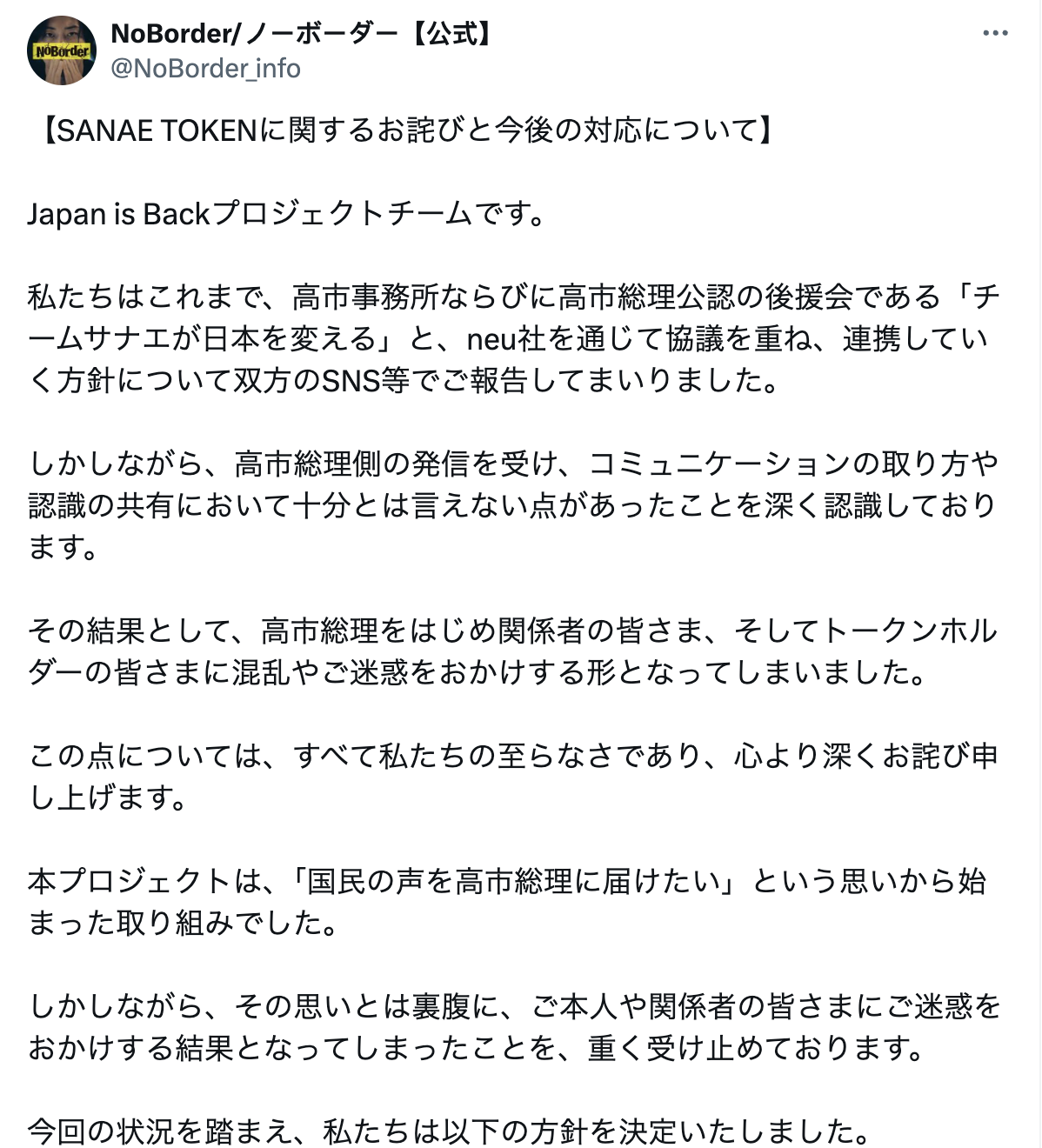
NoBorder’s public statement acknowledged that “communication and recognition-sharing had not been sufficient,” a careful admission of the project's communication failures without fully conceding wrongdoing.
What Role Did The Financial Services Agency of Japan (FSA) Play?
Japan's Financial Services Agency moved with notable speed once the SANAE TOKEN controversy became public, demonstrating how seriously Japanese regulators treat unlicensed crypto operations — especially those with political implications.
The rapid response to the SANAE TOKEN controversy highlights how closely Japan monitors cryptocurrency activities that intersect with politics and financial regulation.
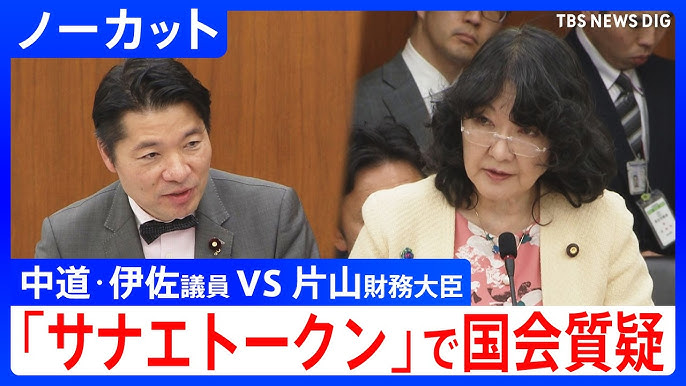
Finance Minister Katayama Satsuki publicly emphasized user protection as the government's top priority at a Cabinet press conference, signaling that this was not a matter regulators intended to let resolve itself quietly.
Key points about Japan's regulatory response and framework:
- The FSA announced its investigation into SANAE TOKEN operators on March 3, just one day after PM Takaichi's public denial
- Finance Minister Katayama Satsuki publicly declared user protection as the government's primary concern
- Under Japan's Payment Services Act, all entities that issue, trade, or facilitate crypto asset exchanges must hold a registered crypto exchange business license
- Operating without this license — as NoBorder did — is a violation of Japanese financial law from the moment the first transaction occurs
- Japan’s strict crypto regulatory framework leaves very little grey area when licensing requirements are unmet, which is why the SANAE TOKEN controversy quickly drew official scrutiny
Source X
Is SANAE TOKEN a Scam? Fraud Allegations Explained
-
Many investors are asking the same question: Is SANAE TOKEN a scam?
At the moment, there is no final legal determination. The situation remains under investigation by Japan’s financial regulators.
Supporters of the fraud allegations argue that:
- The project used the prime minister’s name and likeness without confirmed authorization
- The token was issued without the required financial license
- Investors may have purchased the token based on the impression of political endorsement
However, the project team disputes the accusation of intentional fraud. They note that:
- The official website included a disclaimer stating there was no affiliation
- The token was presented as a community reward mechanism rather than a speculative financial product
- The team believed there had been adequate communication with parties connected to Takaichi’s political network
Because of these conflicting claims, the issue currently falls into a legal grey area. The outcome of the FSA investigation and the independent verification committee will likely determine whether regulatory violations occurred.
Is SANAE TOKEN Legal Under Japanese Crypto Law?
The legality of SANAE TOKEN largely depends on two key factors under financial regulations. However, the project appears to fall short of the first requirement. Understanding these points is important for investors who want to evaluate both the risks and the credibility of the project.
The main legal issues surrounding SANAE TOKEN include the following, key Legal Issues
1. Was the token issued by a registered crypto exchange operator?
The first question is whether SANAE TOKEN was issued by a licensed cryptocurrency exchange operator. In Japan, businesses that handle cryptocurrency trading or brokerage are required to register with the Financial Services Agency (FSA) as a crypto asset exchange service provider.
However, NoBorder—the group behind SANAE TOKEN—was reportedly not registered under this licensing system. This alone raises concerns that the token’s issuance may have violated existing financial regulations.
- No FSA registration: NoBorder — the group behind SANAE TOKEN — was reportedly not registered as a crypto asset exchange service provider under Japan's licensing framework.
- Legal obligation to register: Any entity engaging in cryptocurrency trading or brokerage services in Japan is legally required to obtain FSA registration before conducting such activities.
- Potential regulatory violation: The absence of proper registration raises serious concerns that the issuance of SANAE TOKEN may have been conducted in breach of existing financial regulations.
- Broader implication: Operating without the required license not only exposes the issuer to regulatory and legal liability, but also leaves investors without the protections that the licensing system is designed to provide.
2. Did the project contain potentially misleading representations to consumers?
Another key issue is whether the token’s presentation may have misled consumers. While the official website included a disclaimer stating that the project was not affiliated with PM Sanae Takaichi, the overall marketing materials and visuals suggested a connection to the prime minister.
Ultimately, the legality of SANAE TOKEN will depend on the outcome of the Financial Services Agency’s investigation. The results could determine whether regulatory violations occurred and what actions authorities may take.
- Contradictory messaging: While the official website included a disclaimer stating that the project was not affiliated with PM Sanae Takaichi, the marketing materials and visuals broadly suggested a connection to the prime minister.
- Risk of false impression: This contradiction between the disclaimer and the visual branding may have created a misleading impression among consumers regarding official endorsement or political association.
- Consumer protection concerns: Critics argue that presenting a token in a way that implies political affiliation — even if disclaimed in fine print — could constitute a deceptive or unfair representation under consumer protection standards.
- Regulatory outcome pending: The legality of SANAE TOKEN will ultimately depend on the findings of the Financial Services Agency's ongoing investigation.
- Potential consequences: The investigation's results could determine whether regulatory violations occurred and what enforcement actions authorities may pursue against those responsible.
What Is the SANAE TOKEN Compensation Plan for Holders?
Following the halt of SANAE TOKEN issuance, NoBorder — the group operating the project — announced a formal compensation policy for affected token holders. However, specific details such as compensation amounts and disbursement methods have not yet been publicly disclosed at this time.
According to the announcement, preparations to identify eligible holders are already underway, with wallet records being used as the verification baseline. In response to the controversy, the project itself has also entered a restructuring process, including a name change and an overall review of its operational framework.
For current SANAE TOKEN holders, the most important priorities are understanding who qualifies for compensation, what the eligibility cutoff date is, and how the process will unfold going forward.
The following are the main details of the compensation response that have been confirmed so far.
| Category | Details |
| Eligible Recipients | SANAE TOKEN holders who were affected by the issuance halt |
| Eligibility Cutoff Date | Wallet snapshot taken at noon on March 3, 2026 |
| Snapshot Purpose | Records all wallets holding SANAE TOKEN at that exact timestamp as the official eligibility baseline |
| Compensation Amount | Not yet disclosed — further announcements expected |
| Disbursement Method | Not yet confirmed — whether in fiat, stablecoins, or replacement tokens is pending |
| Project Name Change | SANAE TOKEN will undergo a full name change as part of restructuring |
| Verification Committee | A third-party committee has been established to audit the facts surrounding the controversy |
| Official Updates | All announcements will be made via NoBorder's official X account |
In response to the controversy, SANAE TOKEN is currently undergoing a full project review, including a formal name change. A verification committee — comprising third-party members — has also been established to audit the circumstances surrounding the incident.
Further details regarding compensation specifics and official timelines are expected to be announced through NoBorder's official X account in due course.
What Should SANAE TOKEN Holders Do Right Now?
For current SANAE TOKEN holders, the priority is protecting your eligibility and avoiding actions that could worsen your financial position while the compensation process is unresolved.
The uncertainty surrounding the SANAE TOKEN controversy has created a high-risk environment for investors, particularly during the resolution phase when misinformation and opportunistic scams can spread quickly.
Practical steps for SANAE TOKEN holders to take immediately:
-
Verify your snapshot eligibility:
Confirm that your wallet held SANAE TOKEN at the March 3 noon snapshot. If you acquired the token after that timestamp, you may not qualify for the SANAE TOKEN compensation plan.
-
Do not sell or transfer tokens yet:
Transferring tokens before compensation terms are officially published could affect your eligibility status under the current framework.
-
Avoid secondary DEX purchases:
Do not buy SANAE TOKEN on secondary DEX markets at this stage — buyers entering after the snapshot cutoff have no compensation safety net and are taking on uncompensated risk.
-
Follow official channels only:
Monitor NoBorder's verified X account for SANAE TOKEN compensation plan updates and avoid relying on unverified social media speculation.
-
Document your holdings:
Keep records of your wallet address, transaction history, and token balance at the time of the snapshot in case verification is required.
What Are the Broader Risks of Political Meme Coins?
The SANAE TOKEN controversy is not an isolated event — it is a case study in the structural risks that apply to any political meme coin. These risks are especially pronounced in Japan's strictly regulated crypto environment, where the legal, market, and reputational consequences of a controversy can converge simultaneously with devastating speed.
Risk 1: Does Using a Politician's Name Without Consent Create Legal Problems?
The SANAE TOKEN case provides an unambiguous answer: yes. NoBorder built the token's entire value proposition around PM Takaichi's name, political brand, and public image — without confirmed authorization — and the resulting liability was both legal and reputational in nature. The damage spread far faster than the project team anticipated.

Source X
Key dimensions of this risk:
- Legal liability layer 1: Potential violation of Japan's financial regulations for operating an unlicensed crypto exchange, regardless of name usage
- Legal liability layer 2: Possible portrait rights and personality rights violations under Japanese civil law for using PM Takaichi's image and name in a commercial context without consent
- Reputational damage: The moment Takaichi issued her denial, Team Sanae began deleting posts and scrubbing "official" and "authorized" language from associated merchandise websites — public confirmation of how damaging the implied endorsement had become
- Investor exposure: A political meme coin's core value proposition can evaporate overnight if the named politician publicly walks away — as SANAE TOKEN demonstrated in real time
- A disclaimer buried in website fine print does not provide meaningful protection when the overall product presentation implies endorsement — regulators and courts look at the totality of the presentation
Risk 2 - Why Do Political Meme Coins Collapse After the Initial Hype?
Political meme coins follow a predictable and dangerous price cycle that SANAE TOKEN exemplifies clearly. The pattern is consistent across markets and geographies, but Japan's regulatory environment adds a layer of legal risk that makes the downside steeper than in less regulated markets.
Source X
Key risk factors driving post-hype collapse:
- No underlying utility: Political meme coins spike on name recognition and social media momentum, not on revenue, technology, or real-world use cases — making the price entirely sentiment-dependent
- Global precedent: TRUMP coin and MELANIA coin in the US both followed the same pattern — massive launch pumps followed by steep, sustained price collapses as hype faded and no fundamental value emerged
- Japan's compounding risk: In the US, political meme coins launched in a relatively permissive short-term regulatory environment; in Japan, the Payment Services Act's licensing requirements mean legal risk and market risk hit simultaneously
- Insider advantage: Early community members, influencers, and project teams typically hold tokens at launch cost or below — retail investors who enter after the hype peak absorb the losses when sentiment reverses
- SANAE TOKEN outcome: The issuance halt and name change announcement effectively wiped out speculative value for late buyers, confirming the pattern in the Japanese context
Risk 3 - Why Do Political Tokens Face Stricter Regulatory Scrutiny in Japan?
Japan's regulatory response to the SANAE TOKEN controversy — FSA investigation within days, Finance Minister public statement within the same week — reflects a structural reality: political tokens occupy an ambiguous space that triggers multiple regulatory frameworks simultaneously, and Japan's regulators are well-equipped and motivated to act quickly.
Source X
Key reasons Japan's regulatory risk is higher for political meme coins:
- Multi-framework exposure: Political tokens touch crypto licensing law, political fundraising regulations, consumer protection rules, and potentially securities law all at once — making them a priority target for multiple regulatory bodies
- Payment Services Act enforcement: Japan's FSA has clear legal authority and a track record of rapid enforcement when crypto operators are found to lack required licensing
- Political sensitivity: A token bearing a sitting prime minister's name is inherently high-profile — regulators cannot afford to appear inactive when public officials are involved
- Comparison with the US: TRUMP coin and MELANIA coin faced limited immediate regulatory intervention at launch; Japan's FSA acted within 72 hours of the SANAE TOKEN controversy going national
- Investor takeaway: In Japan, any token with political branding carries an elevated risk of sudden regulatory action — which can trigger an immediate halt, asset freeze, or compensation process that leaves holders in limbo with no clear resolution timeline
How Can You Safely Access and Swap Tokens Like SANAE TOKEN Using Bitget Wallet?
Controversies like the SANAE TOKEN situation make one thing clear: the tools you use to access on-chain tokens matter as much as the research you do beforehand. Having transparent, real-time data about liquidity, contract addresses, and price impact is the difference between informed participation and blind speculation. Here is a practical, safety-first guide to navigating tokens like SANAE TOKEN responsibly using Bitget Wallet.
⚠️ Brand Announcement:
Bitget Wallet is not affiliated with the SANAE project, nor does it issue or operate the token. This guide is based on public on-chain data and market information, explaining the token and how users may obtain it.
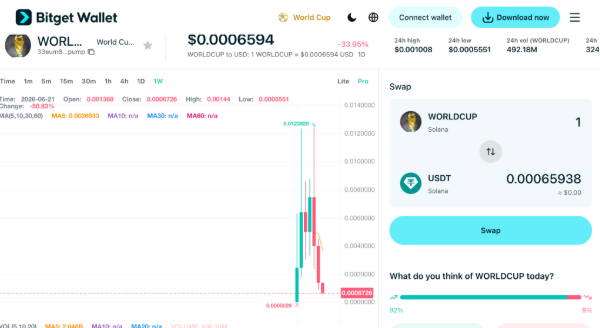
Through the Swap feature in Bitget Wallet, users may be able to exchange tokens for SANAE Token via liquidity pools on Solana DEXs. Because DEXs rely on on-chain liquidity, if a token has an active liquidity pool, it can potentially be swapped through the wallet interface. However, this does not imply that Bitget Wallet lists, issues, or recommends the token.
Step 1: Create an Account
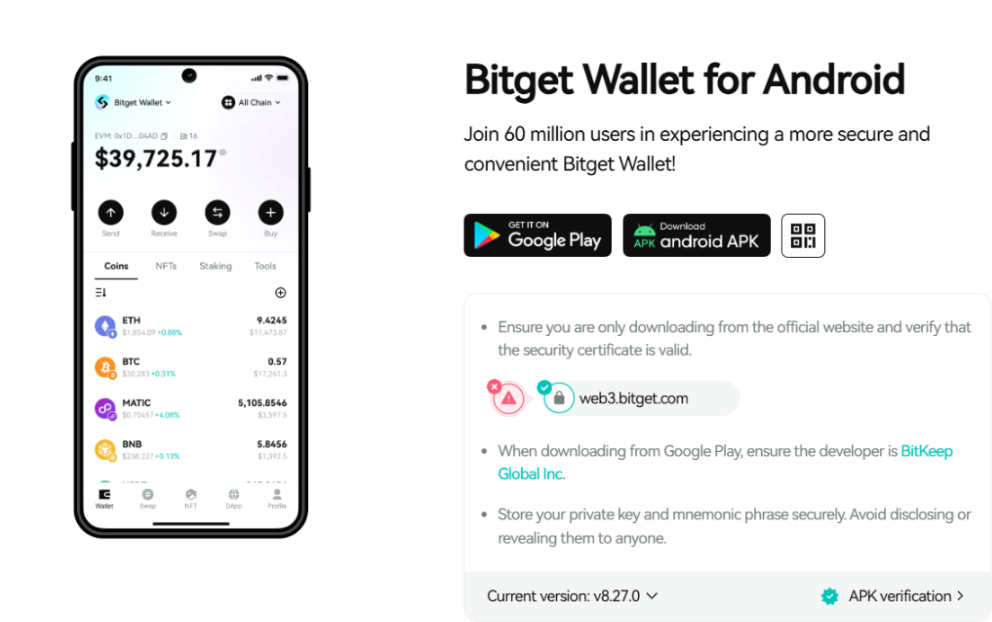
If you don't have an account, download the Bitget Wallet app. Sign up by providing the necessary information and verifying your identity.
Step 2: Deposit Funds
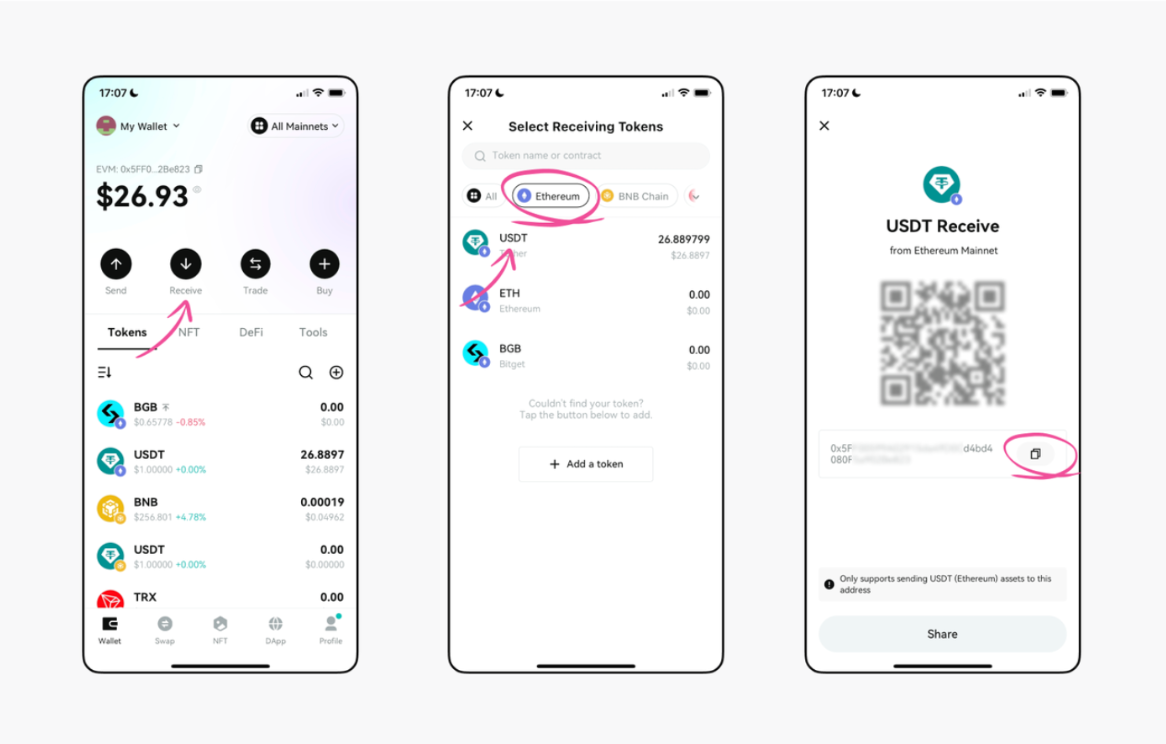
Once your account is set up, you need to deposit funds. You can do this by:
- Transferring Cryptocurrency: Send crypto from another wallet.
- Buying Crypto: Use a credit or debit card to purchase crypto directly on Bitget Wallet, ensuring you have enough funds for trading SANAE token.
Step 3: Find SANAE Token
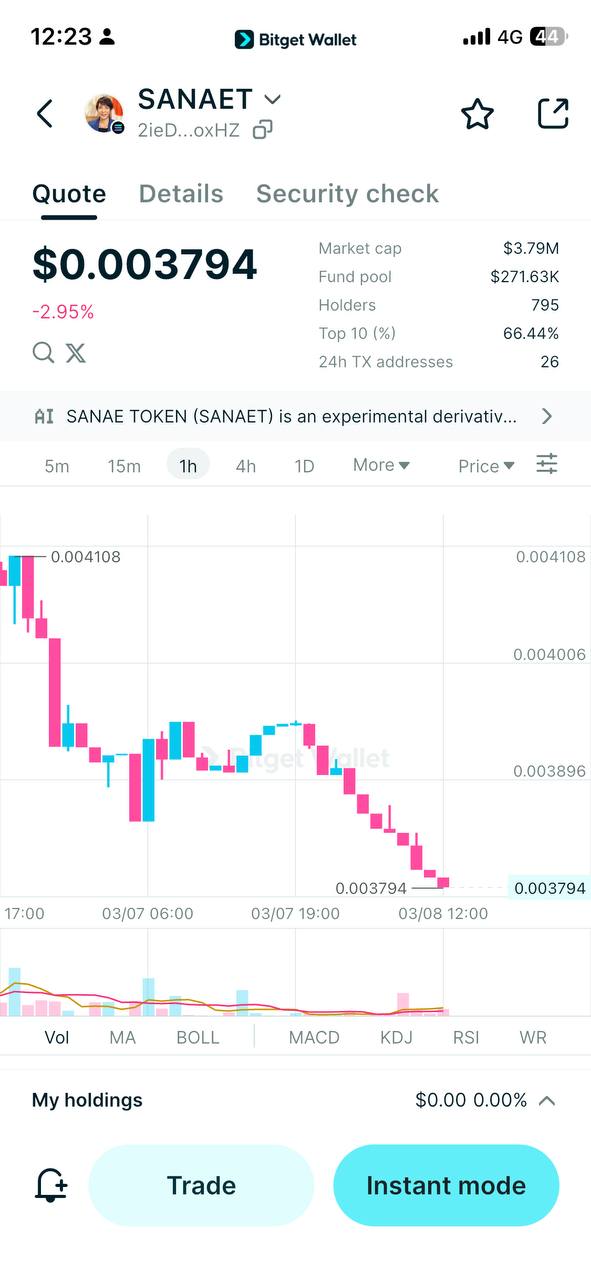
In the Bitget Wallet interface, navigate to the market section. Use the search bar to find SANAE token. Click on the token to view its trading page.
Since this token has not been listed yet, please refer to the final contract address provided by the project team after the token is officially listed.
Step 4: Choose Your Trading Pair
Select the trading pair you wish to use, such as [Token Name]/USDT. This will allow you to trade SANAE token against USDT or another cryptocurrency.
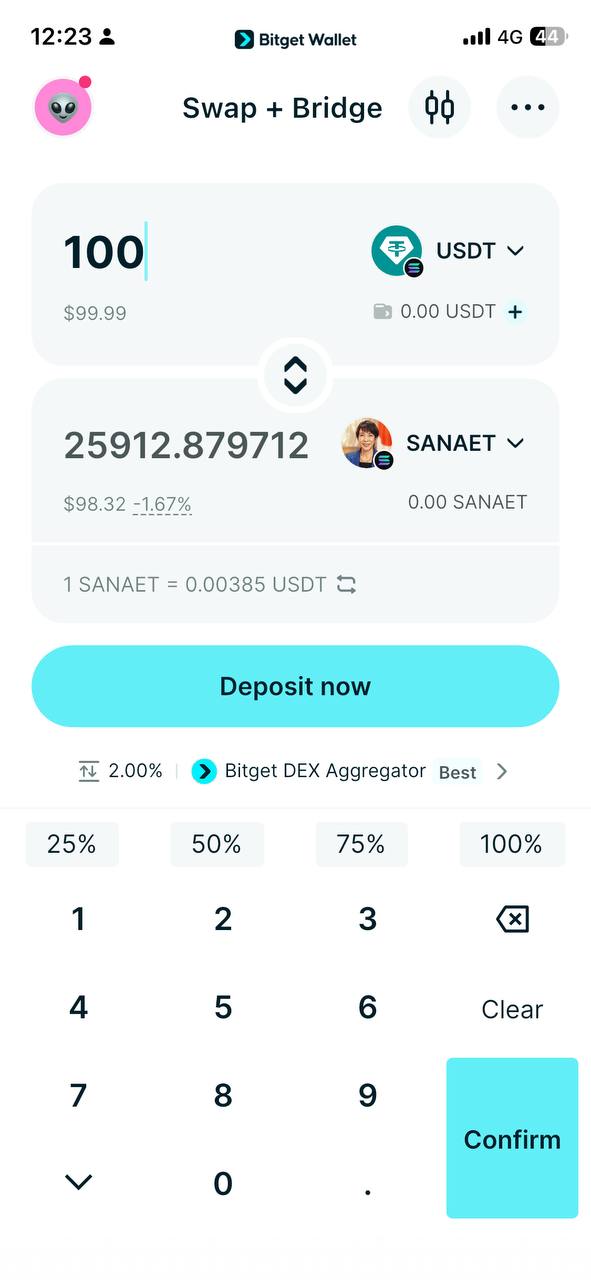
Step 5: Place Your Order
Decide whether you want to place a market order (buy/sell at the current market price) or a limit order (set your own price). Enter the amount of SANAE token you wish to buy or sell, then confirm your order.
Step 6: Monitor Your Trade
After placing your order, you can monitor its status in the “Open Orders” section. Once the order is executed, you can check your balance to see your newly acquired SANAE token.
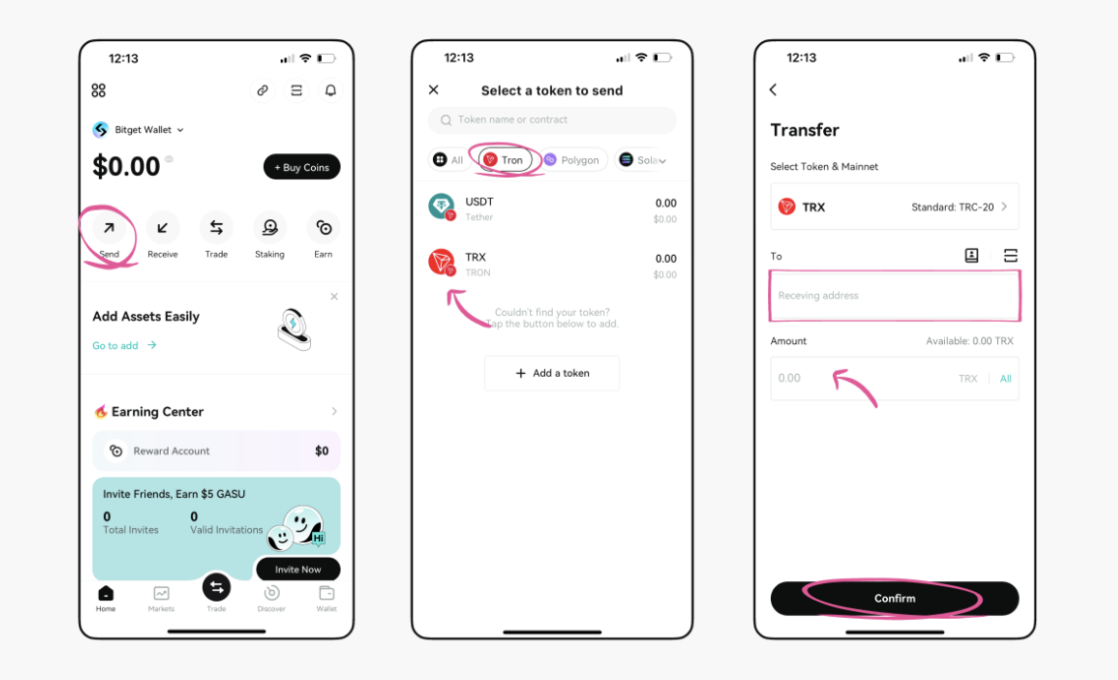
Step 7: Withdraw Your Funds (Optional)
If you wish to transfer your SANAE token or any other cryptocurrency to another wallet, navigate to the withdrawal section, enter your wallet address, and confirm the transaction.
▶ Learn more about SANAE token:
- How to buy SANAE token
- What Is SanaeCoin (SANAE): Understanding Japan Prime Minister Sanae Takaichi’s Political Token
Bitget Wallet supports multi-chain access, on-chain token discovery, and real-time DEX data, making it a practical choice for investors who want a clear view of what they are entering before committing capital — rather than acting on hype alone.
Conclusion
The SANAE TOKEN controversy highlights how quickly legal, political, and financial risks can converge in the cryptocurrency market.
The project’s use of a sitting prime minister’s name combined with licensing concerns triggered rapid regulatory scrutiny in Japan. As a result, token issuance was halted, the project entered restructuring, and a compensation plan for affected holders is now being prepared. However, the legal status of SANAE TOKEN remains unresolved until the Financial Services Agency completes its investigation. Investors should therefore treat the token with caution and avoid assuming regulatory compliance until official findings are released. More broadly, the situation demonstrates the risks associated with political meme coins, particularly in countries like Japan where crypto regulation is strict and enforcement can move quickly.
For investors navigating on-chain assets, using reliable infrastructure and transparent tools is essential. Platforms like Bitget Wallet allow users to access real-time blockchain data, verify token contracts, and interact with decentralized exchanges while maintaining full control of their assets.
Staying informed, verifying information carefully, and prioritizing secure wallet tools remain the best ways to reduce risk in the evolving crypto ecosystem.
Sign up Bitget Wallet now - grab your $2 bonus!
FAQs
1. What Is the SANAE TOKEN Controversy and Is the Project a Scam?
The SANAE TOKEN controversy centers on whether the project misled investors by using the name and image of Japanese Prime Minister Sanae Takaichi without confirmed authorization. While many investors have raised fraud concerns, no final legal determination has been made.
The allegations are based on several issues: the use of the prime minister’s public identity in the project’s branding, the lack of a required crypto exchange license, and the financial losses some investors experienced after Takaichi publicly denied involvement. However, the project team stated that a disclaimer was included and described the token as a civic engagement incentive rather than a purely speculative crypto asset.
2. Why Was SANAE TOKEN Issuance Halted and Will the Project Continue?
The halt of SANAE TOKEN issuance occurred after the situation escalated during the SANAE TOKEN controversy. Prime Minister Takaichi publicly denied involvement with the project on March 2, which removed the perceived political association that had drawn public attention to the token.
Shortly afterward, Japan’s Financial Services Agency announced an investigation, confirming that the project operator lacked the required crypto exchange business license under the Payment Services Act. As a result, the issuing organization halted the project and began reviewing its structure and compliance status.
3. How Will SANAE TOKEN Holders Be Compensated?
According to the project’s announcement, compensation will be provided to affected token holders following the events surrounding the SANAE TOKEN controversy. However, the exact compensation amount and payment method have not yet been publicly disclosed.
Eligibility will be determined using a wallet snapshot taken on March 3. Only wallets holding SANAE TOKEN at that time will qualify under the current compensation framework.
Risk Disclosure
Please be aware that cryptocurrency trading involves high market risk. Bitget Wallet is not responsible for any trading losses incurred. Always perform your own research and trade responsibly.