


ZKsync Airdrop Launch: How to Participate and Claim $ZK Rewards
ZKsync (ZK), an Ethereum Layer2 protocol built on zk-rollup technology, has become one of the most closely watched scaling solutions following its token airdrop and exchange listings in 2024. Developed by Matter Labs, ZKsync focuses on high-throughput, low-cost transactions while maintaining Ethereum-level security through zero-knowledge proofs. The protocol has seen broad adoption across DeFi, NFT, and on-chain trading applications, with a rapidly growing ecosystem of dApps and active wallets interacting on ZKsync Era.
This guide breaks down what actually matters for users and traders today: how the ZKsync airdrop claim works, what influenced $ZK’s post-listing price behavior, and how allocation design and sybil filtering debates shaped community response. You’ll also learn how to access $ZK after listing and what to evaluate before participating in the ZKsync ecosystem going forward.
Use Bitget Wallet to access $ZK on-chain and manage your assets securely across multiple networks.
What Is ZKsync (ZK)?
ZKsync (ZK) is a Layer2 network that uses zk-rollups to batch and verify transactions off-chain, then finalize them on Ethereum using cryptographic proofs. Unlike many scaling solutions, ZKsync implements native account abstraction, allowing wallets to operate without traditional private key constraints (e.g., social recovery, multi-sig logic at protocol level).
The ZK token functions as a governance and ecosystem coordination asset, used for protocol upgrades, incentive alignment, and future decentralization of network control. Its distribution through the airdrop was based on on-chain behavior, including bridging activity, contract interactions, and liquidity participation on ZKsync Era.
Is ZKsync (ZK) Legit?
ZKsync operates as a production-level Layer2 with live applications, active liquidity, and continuous network usage, rather than a pre-launch or speculative-only token. Its infrastructure is already integrated across wallets, DeFi protocols, and bridges, which distinguishes it from short-lived airdrop-driven projects.
That said, the $ZK airdrop introduced allocation disputes, particularly around sybil filtering accuracy and eligibility exclusions. While this does not invalidate the protocol itself, it highlights ongoing challenges in fair token distribution—making it important for users to evaluate both the technology and the surrounding ecosystem dynamics before participating.

Source: X
ZKsync (ZK) Airdrop Timeline
Participants should focus on the actual distribution lifecycle and 2026 token events, rather than a new claim phase:
| Date | Events |
| March 24, 2024 | Snapshot taken — user eligibility finalized based on on-chain activity on ZKsync Era |
| June 17, 2024 | $ZK airdrop claim opens and token begins trading on major exchanges |
| January 3, 2025 | Final deadline to claim $ZK airdrop tokens |
| April 17, 2026 | Scheduled token unlock for investors and contributors, increasing circulating supply |
| May 4, 2026 | ZKsync Lite network sunset; users required to migrate funds to ZKsync Era |
- Please refer to the official announcement for the most accurate schedule.
Pro Tip: ZKsync’s airdrop was retroactive, meaning eligibility was locked before March 2024. As of 2026, there is no new claim phase—market impact now comes from token unlocks and ecosystem incentive distributions, not additional airdrop participation.
Tokenomics of ZKsync (ZK): Key Insights and Allocations
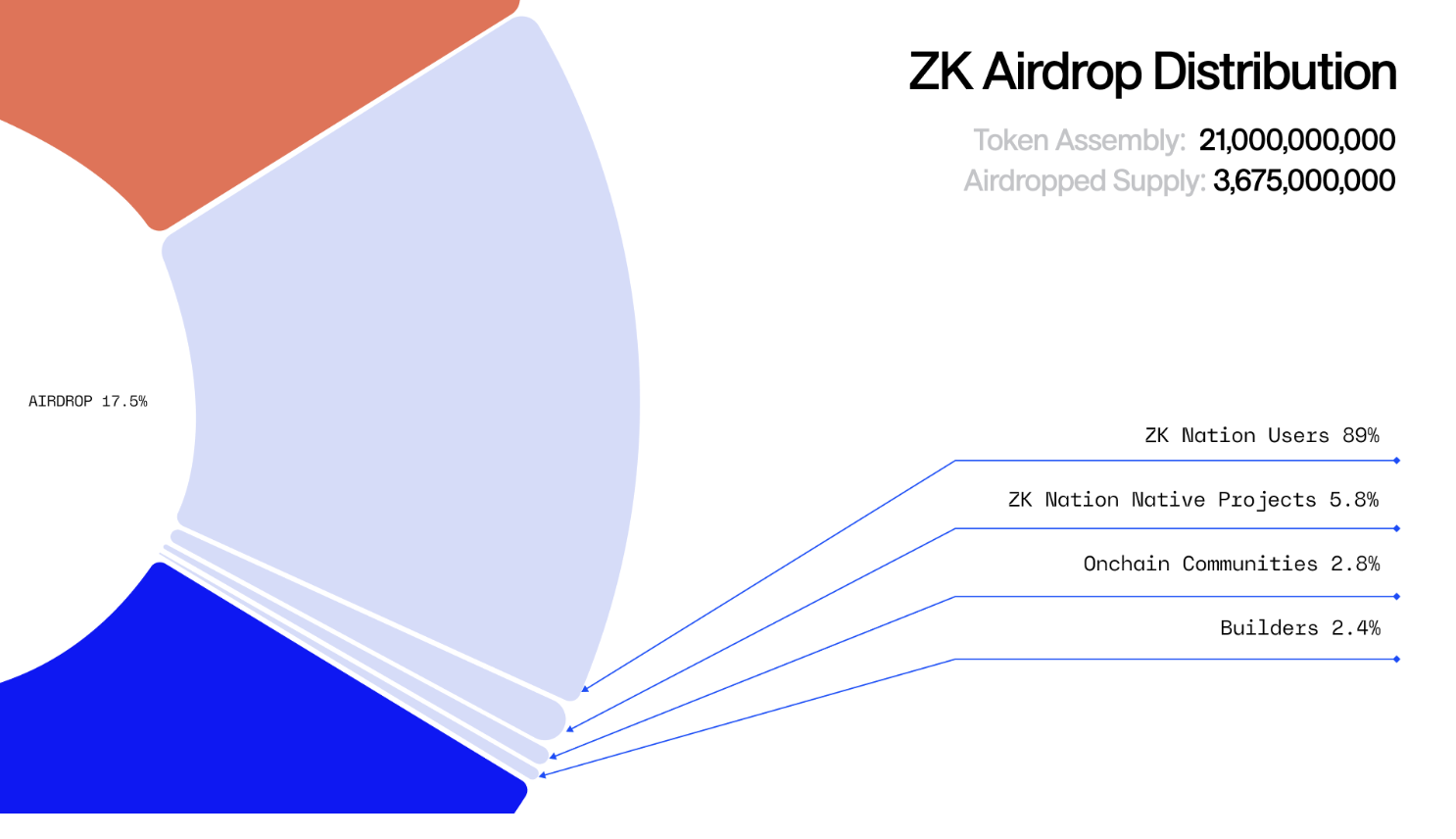
ZKsync (ZK) follows a large-scale, ecosystem-driven distribution model designed to decentralize governance while funding long-term network growth:
- Total Supply: 21 billion $ZK tokens
- Community Allocation (67.5%):
- 17.5% Airdrop (Genesis Distribution): Distributed to eligible users and contributors based on historical on-chain activity, with no vesting for recipients
- ~49% Ecosystem Incentives: Reserved for ongoing grants, liquidity programs, and user incentives managed by the ZKsync Foundation over multiple years
- Investors and Team (32.5%):
- Allocated to early backers and core contributors
- Subject to multi-year vesting schedules, with periodic unlock events (including 2026 supply releases) impacting circulating supply
This structure reflects ZKsync’s focus on retroactive user distribution combined with long-term ecosystem funding, rather than short-term emission models.
How to Participate and Claim Rewards in the ZKsync (ZK) Airdrop?
Step 1: Check Eligibility on the Official Portal
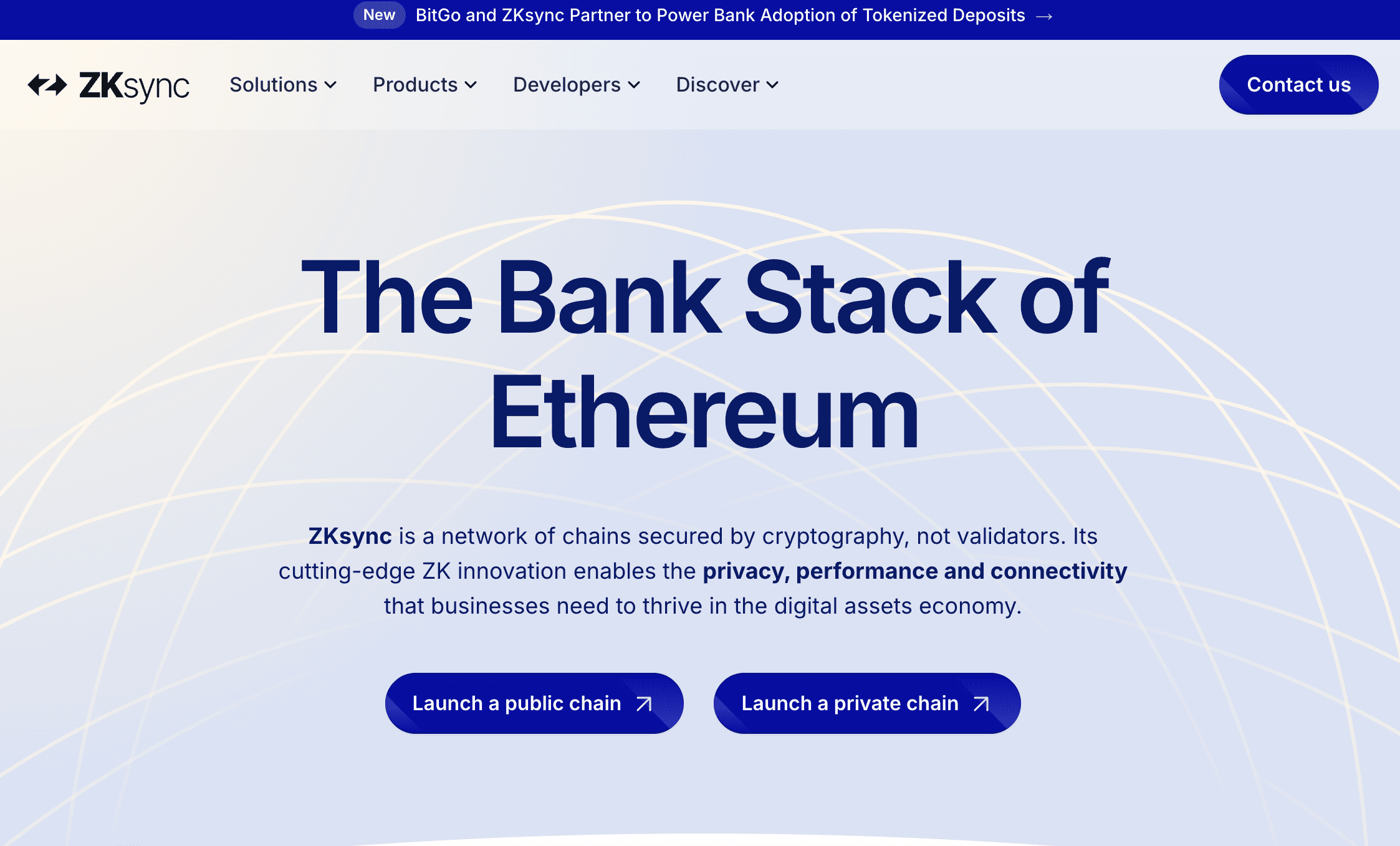
Users needed to connect a wallet used on ZKsync Era to verify eligibility. Allocation was determined by historical on-chain activity—including bridging funds, interacting with smart contracts, and providing liquidity—rather than completing tasks after announcement.
👉 Important: As of 2026, the claim phase has ended, but this process remains relevant for understanding how ZKsync structured its distribution.
Step 2: Understand How Allocation Was Calculated
Unlike typical “task-based” airdrops, ZKsync used a retroactive scoring model, where rewards were assigned based on:
- Wallet activity across ZKsync Era
- Frequency and consistency of transactions
- Interaction with DeFi protocols and dApps
- Contribution to ecosystem growth
Step 3: Verify Your Bitget Wallet Account
To connect your wallet and access the ZKsync claim interface, use WalletConnect:
- Open the official ZKsync claim page and select Connect Wallet
- Choose WalletConnect
- In Bitget Wallet, tap WalletConnect / Scan and scan the QR code
- Verify the domain (e.g., zknation.io) → tap Connect
- Approve the request and proceed
To claim ZKsync (ZK) tokens, users need a Web3 wallet that supports ZKsync Era and standard token storage. Many users choose Bitget Wallet because it integrates smoothly with WalletConnect and allows them to manage $ZK alongside assets across multiple networks after distribution.
Step 4: Claim Your $ZK Tokens (Historical Process)
Once eligible, users could submit a claim transaction directly on the ZKsync network. Tokens were then transferred to the connected wallet, with no vesting applied to the airdrop allocation.
👉 Note: The official claim window closed on January 3, 2025, and unclaimed tokens were reallocated to ecosystem programs.
Actionable Tips
- Verify sources carefully: Only use official ZKsync or ZK Nation links—phishing attempts were common during the claim phase
- Check wallet history: Eligibility depended on past activity, not new actions
- Understand allocation logic: Large balances alone did not guarantee higher rewards—interaction quality mattered
- Track post-airdrop changes: In 2026, token unlocks and ecosystem incentives have a greater impact than the original airdrop
ZKsync (ZK) Listing: Launch Date, Pre-Market Price, Total Supply
- Launch Date: June 17, 2024
- Exchange: Binance
- Pre-market Price: Early trading ranged between ~$0.24–$0.31, with rapid volatility during initial listing hours
- Total Supply: 21,000,000,000 $ZK tokens, with 17.5% allocated to the initial airdrop and a majority reserved for ecosystem incentives and long-term distribution
ZKsync (ZK) Price Predictions
As ZKsync (ZK) continues to trade in its post-airdrop phase, price expectations are primarily influenced by token unlocks, circulating supply expansion, and ecosystem usage rather than early hype cycles:
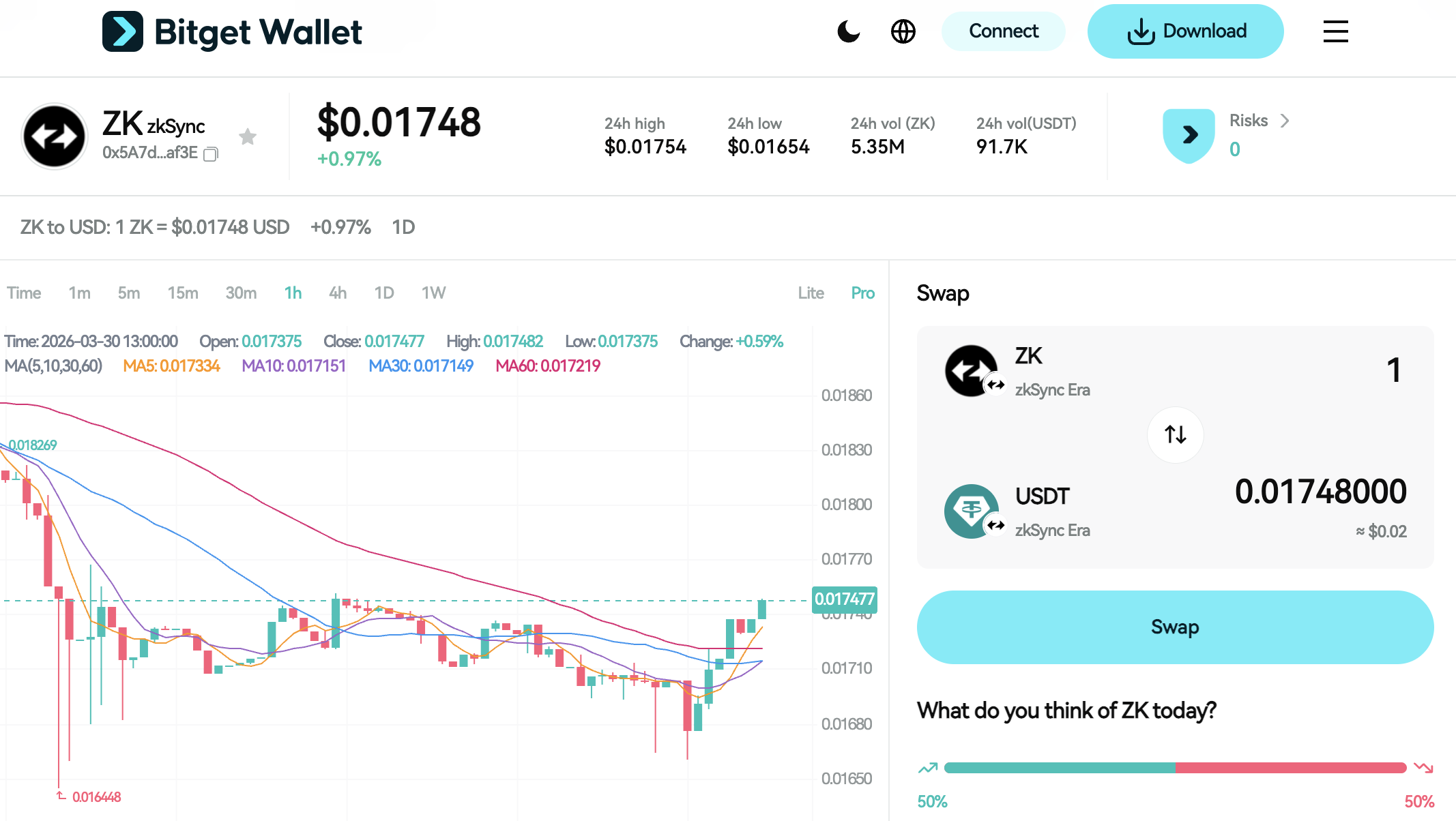
- Short-Term (1–3 Months): $ZK is expected to fluctuate within the $0.015–$0.035 range, reflecting ongoing volatility tied to token unlock events and overall market sentiment.
- Medium-Term (6–12 Months): If ZKsync’s ecosystem activity (DeFi usage, TVL, dApp adoption) strengthens, $ZK could stabilize and trade in the $0.03–$0.08 range.
- Long-Term (1 Year or More): Under favorable conditions—such as sustained Layer2 adoption, increased network usage, and controlled supply expansion—$ZK may trend toward the $0.08–$0.15 range, though this remains highly dependent on broader market cycles.
Source: CoinGecko
Note: The price prediction is sourced from third-party analysis and market observations at the time of writing. It does not represent the official stance of ZKsync or Bitget Wallet. Please conduct your own research and refer to real-time market data before making investment decisions.
Source: Bitget Wallet
What's Next for ZKsync (ZK)?
Since its token launch, ZKsync (ZK) has shifted from airdrop-driven activity to a supply-driven and utility-focused phase, with growth shaped by:
- Ongoing token unlocks: Scheduled releases in 2026 continue to increase circulating supply, directly impacting price dynamics
- ZKsync Lite sunset (May 4, 2026): Users are required to migrate assets to ZKsync Era, consolidating liquidity into a single network
- Ecosystem incentives (~49% allocation): Long-term funding for DeFi, gaming, and infrastructure projects building on ZKsync Era
By focusing on these pillars, ZKsync (ZK) is positioning itself as a core zk-rollup infrastructure layer within the Ethereum Layer2 ecosystem, where adoption and on-chain activity will determine its long-term relevance.
▶Learn more about ZKsync (ZK):
Which Crypto Wallet Is Best for ZKsync (ZK): Bitget Wallet
For ZKsync (ZK), users need a wallet that supports ZKsync Era, cross-chain asset management, and on-chain trading after listing. Bitget Wallet fits this use case by allowing users to manage $ZK, interact with ZKsync-based dApps, and swap tokens across networks without moving funds to centralized exchanges.
Why Bitget Wallet Works for ZKsync
- ZKsync Era support: Store and manage $ZK directly
- WalletConnect compatibility: Access ZKsync dApps and protocols
- Cross-chain access: Move assets between Ethereum and Layer2 networks
- In-app trading: Swap $ZK and other tokens as liquidity evolves
How Users Actually Use Bitget Wallet with ZKsync
- Store $ZK after withdrawing from exchanges
- Connect to ZKsync dApps using WalletConnect
- Bridge assets between Ethereum and ZKsync Era
- Swap $ZK or other tokens as liquidity develops
Use Bitget Wallet to manage $ZK and interact with the ZKsync ecosystem directly on-chain.
Conclusion
The ZKsync (ZK) airdrop claim on March 30, 2026 quickly became one of the most discussed Layer2 events, combining high participation with immediate price volatility and community concerns around sybil filtering. Instead of a straightforward reward distribution, it highlighted how airdrop outcomes depend on allocation structure, circulating supply at launch, and early market liquidity conditions.
For users navigating the post-airdrop phase, the priority shifts to secure storage, cross-chain access, and flexible execution as $ZK trading evolves across both centralized and on-chain markets. Using a non-custodial solution like Bitget Wallet allows users to manage $ZK, interact with ZKsync-based applications, and respond to market changes without giving up asset control.
👉 Don’t miss the opportunity to join the next wave of blockchain adoption. Download Bitget Wallet today and secure your spot in the ZKsync ecosystem.
Sign up Bitget Wallet now - grab your $2 bonus!
FAQs
1. How was the ZKsync (ZK) airdrop claimed on March 30, 2026?
The claim opened on March 30, 2026 (08:00 UTC) through ZKsync’s official interface. Eligible users connected a ZKsync Era–compatible wallet, checked allocation results, and completed an on-chain claim transaction based on predefined activity snapshots.
2. What caused the ZK token price drop after listing?
The initial price pressure was driven by airdrop-related sell activity and early circulating supply entering the market simultaneously. This created short-term imbalance between liquidity and sell volume during the first hours of trading.
3. Why is the ZKsync sybil detection being questioned?
Some users reported inconsistencies in allocation results, claiming that certain multi-wallet farming patterns were not fully filtered, while others with genuine activity were excluded. This led to broader discussion around the effectiveness of ZKsync’s sybil detection model.
4. How much did users actually receive from the ZKsync airdrop?
Allocation varied significantly depending on wallet activity, usage patterns, and eligibility tier. Final outcomes differed per address and were also influenced by market conditions at the time of claim and trading.
5. What happens after the ZKsync airdrop distribution?
After distribution, $ZK transitions into a market-driven asset, where price and utility depend on ecosystem adoption, liquidity conditions, and ongoing network activity within ZKsync Era.
Risk Disclosure
Please be aware that cryptocurrency trading involves high market risk. Bitget Wallet is not responsible for any trading losses incurred. Always perform your own research and trade responsibly.

 eCashAirdrop Launch: How to Participate and Claim $XEC Rewards2026-04-28 | 5 mins
- Ink (INK) Airdrop Launch: How to Participate and Claim $INK Rewards2026-04-28 | 5 mins
 Genius Terminal Airdrop Launch: How to Participate and Claim $GENIUS Rewards2026-04-23 | 5 mins



